
In this month's Sky Notes:
- Planetary Skylights
- June Meteors, Noctilucent cloud, T CrB
- Summer Solstice
- June Night Sky
- June 2026 Sky Charts
Planetary Skylights: A Brief Guide to June's Night Sky
Venus and Jupiter come together in the evening twilight sky, before Jupiter departs the sky. Mercury also shows up for the planetary party and is just about visible lower right of the squabbling pair. Saturn and Mars are visible in the early morning sky but remain somewhat challenging for UK observers.
 Venus is the dominant planetary presence in the evening sky, outshining departing Jupiter, the pair in conjunction early June. At magnitude -4.0, Venus is a dazzling spectacle low in the late evening twilight above the west horizon but will not ascend any higher into the sky after the first week of June. Over the course of this same period watch as Venus and Jupiter converge, the separation between them closest from June 8th - 10th (around one and a half degrees on the 9th). Thereafter the two will go their separate ways, Jupiter horizon bound later in the month, whilst Venus maintains its altitude.
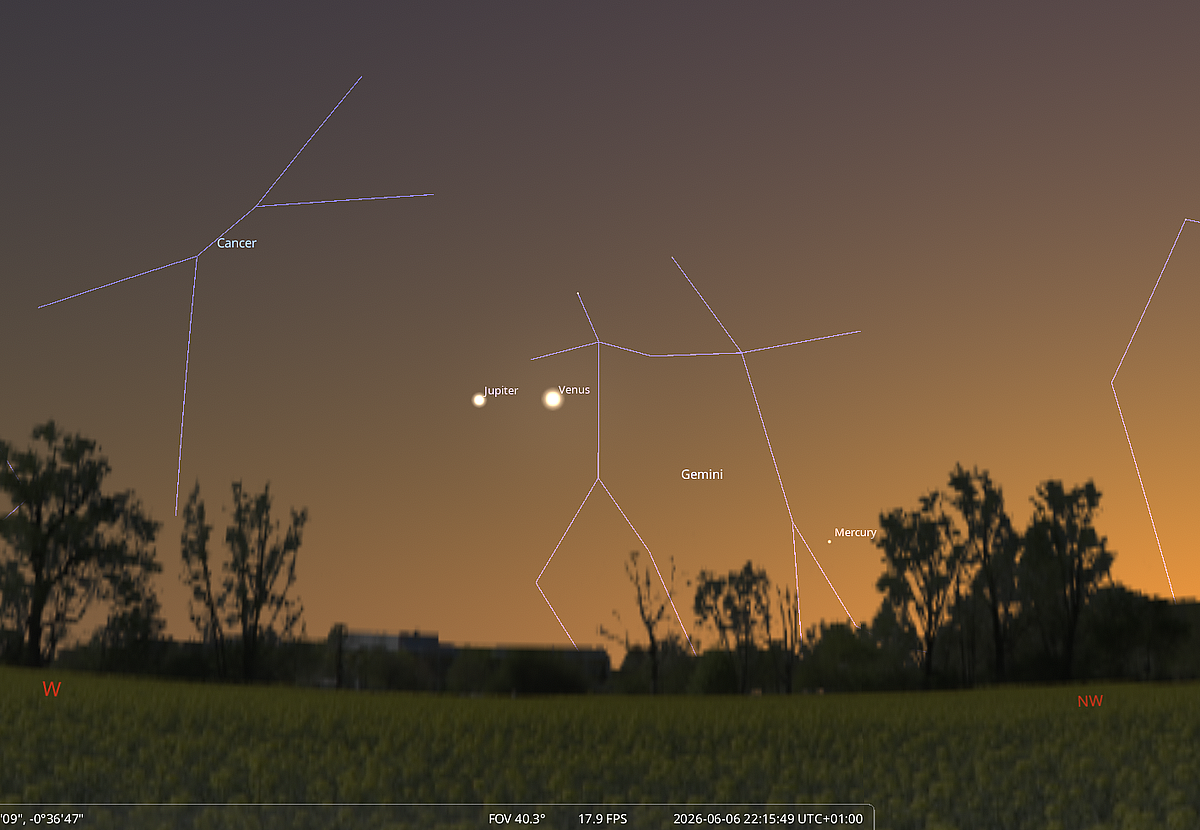
Venus and Jupiter side by side - June 6th @ 22:15hrs. (Click for full image)
It’s not the only conjunction Venus is involved in this month, having a very close encounter with a slender crescent Moon on June 17th. Venus will lie just over 22 arcminutes above the Moon on that evening, view around 22:25hrs for another fine photo opportunity!
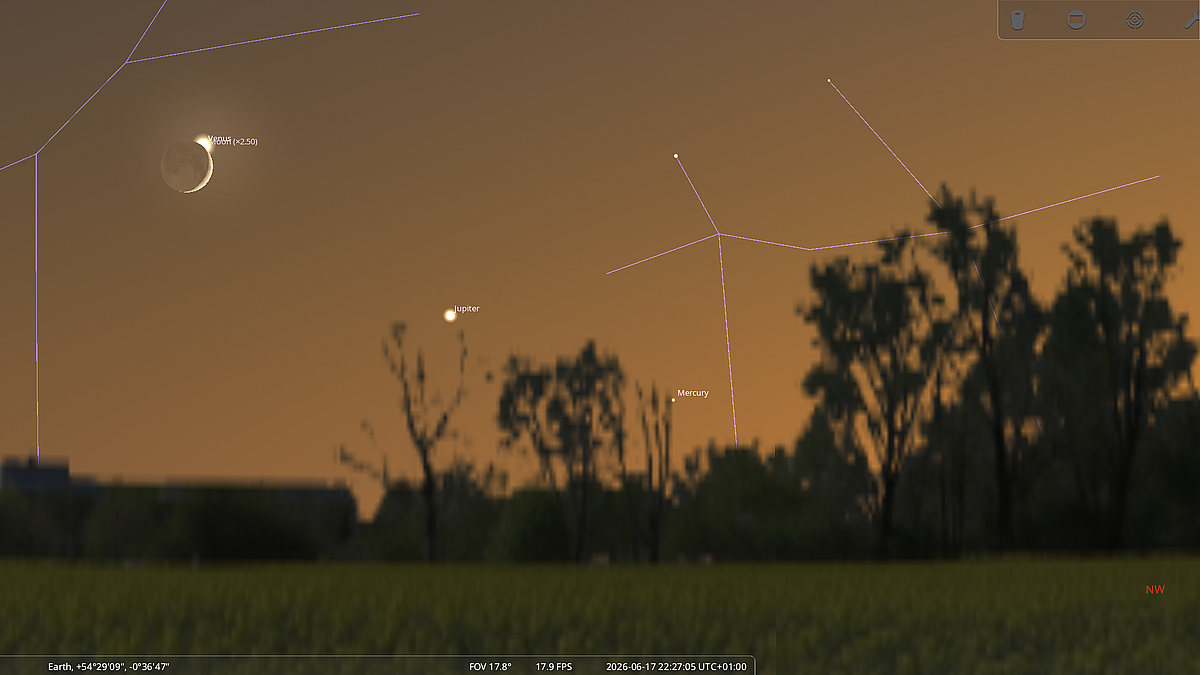
June 17th - 22:25hrs. Venus, Moon, Jupiter and Mercury. (Click for full image)
Point a telescope at Venus and the view will reveal little detail; the planet perpetually shrouded in cloud. It should however be possible to discern a phase, which diminishes from 79% to 68% over the course of the month. A good observing tip when viewing Venus through a telescope is to do so in brighter twilight, thus reducing glare.
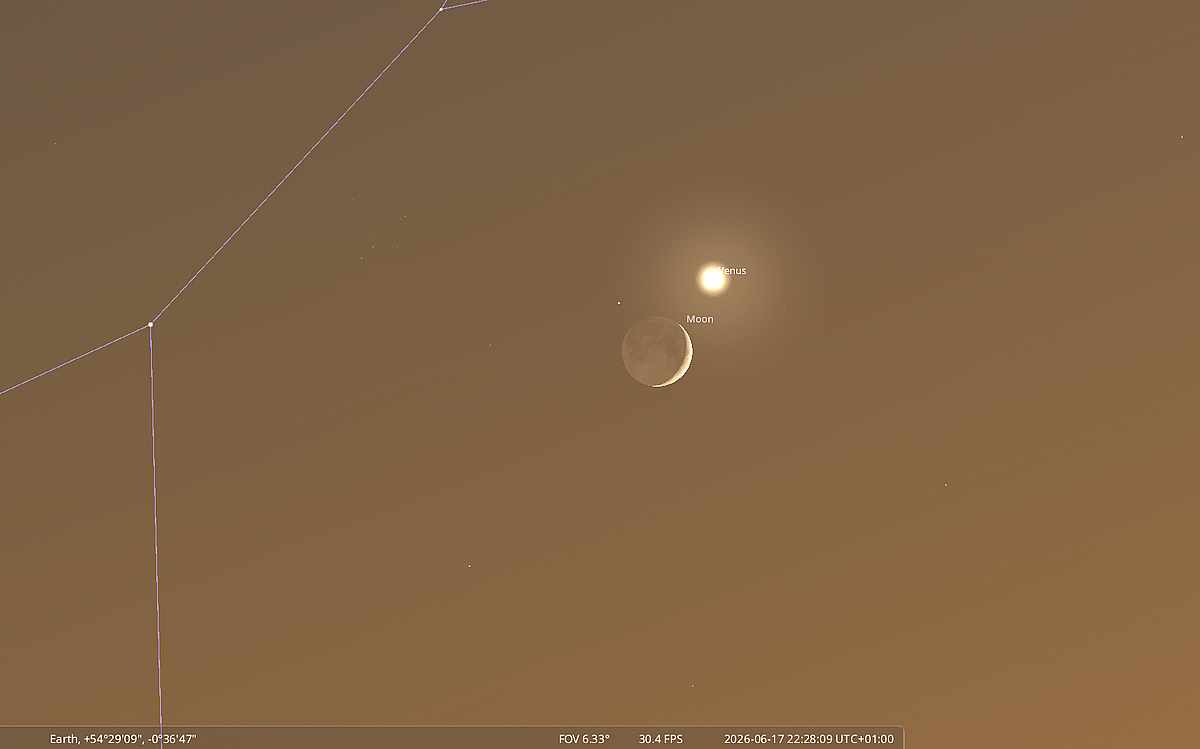
Venus and crescent Moon - June 17th @ 22:25hrs. (Click for full image)
 Jupiter finally succumbs to bright twilight and the WNW horizon, departing the evening sky shortly after mid-month. As already highlighted, it is involved in a fine conjunction with Venus earlier in the month, the two most prominent planets clashing in the late evening sky. Telescopic observations of Jupiter will be challenging as it drops toward the WNW horizon. If 'seeing' is good early in the month, some detail may be discerned, in particular the two main cloud belts. The Galilean moons should also be visible. Jupiter will be lost to the horizon from mid-northern latitudes by June 20th, setting around 23:00hrs.
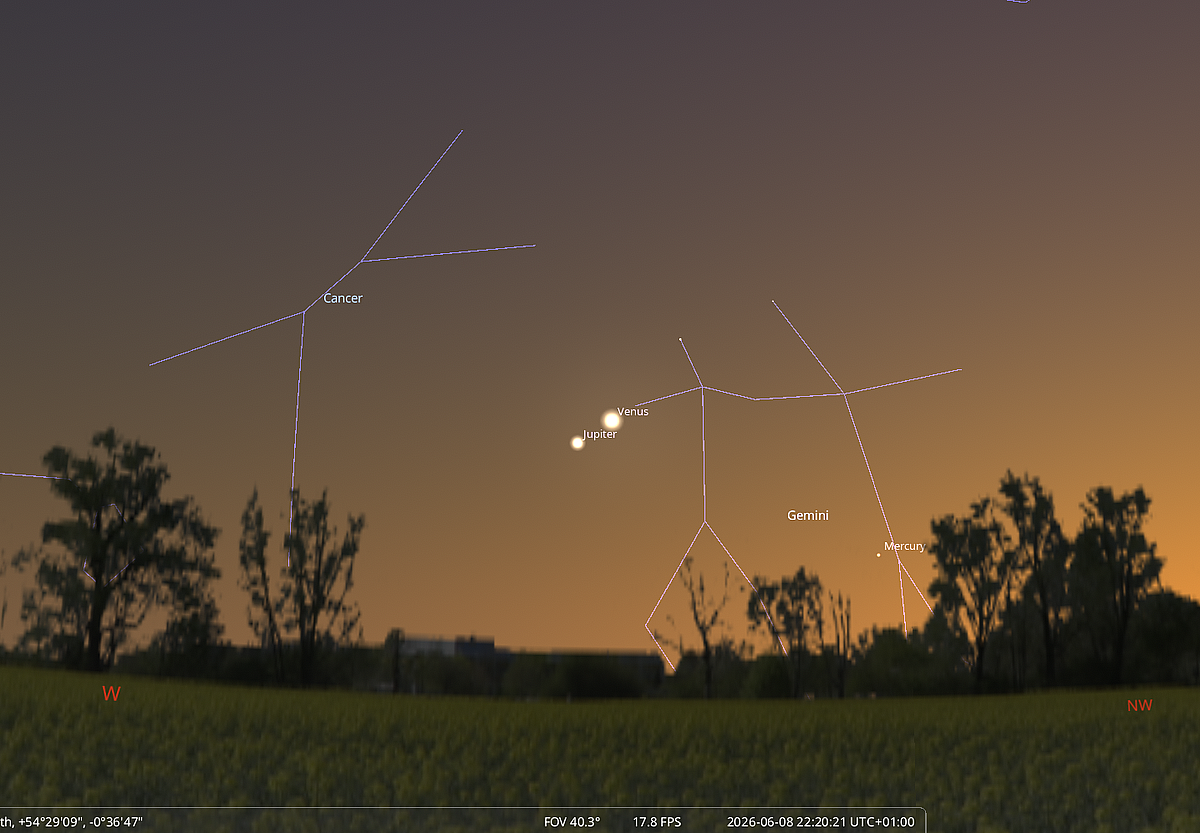
Jupiter and Venus on June 8th around 22:20hrs. (Click for full image)
 Mercury continues with a challenging evening apparition for UK observers into June, pulling out to greatest eastern elongation from the Sun on June 15th. Initially appearing reasonably bright at magnitude -0.5, Mercury only reaches a maximum elevation of approximately 5.5 degrees above the west-northwest horizon and a flat aspect in that direction is a must in order to spot it. Look for this elusive world on a bearing of 305 degrees, using binoculars as an aid, the projected magnitude diminished by poor 'seeing' at such low altitudes. Mercury will gradually fade as the apparition continues into June, ending by the 20th. View from 22:15hrs at the start of June to 22:25hrs by the 16th. On this date a very slim crescent Moon will lie directly above Mercury, but you will require a flat aspect. Challenging, yes - but worth having a go!
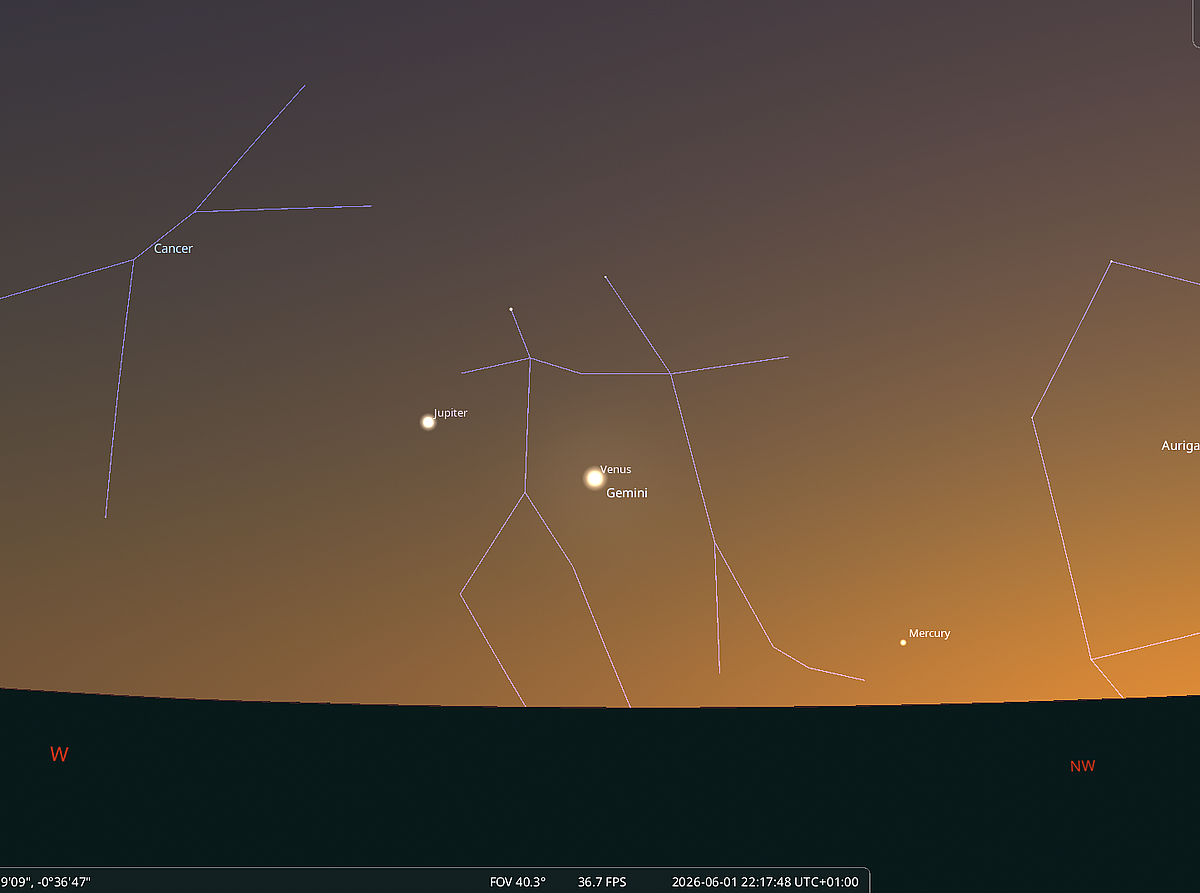
Mercury just above the NW horizon early June around 22:15hrs. (Click for full image)

Mercury below crescent Moon, Jupiter and Venus also in the frame - June 16th - 22:25hrs.
(Click for full image)
 Saturn continues to edge away from the Sun in the early dawn sky, visible from UK latitudes just above the horizon due east around 03:15hrs at the start of June. It will then have an observing window of just 40 minutes before skies become too bright. By the end of the month however, this will have increased to over 2 hours, Saturn rising shortly after 01:00hrs. Saturn's elevation will also increase correspondingly, from approximately 4 degrees at the start of June to around 20 degrees by the time skies lighten at the month's end. Telescope observations of Saturn should be viable by then (albeit for a short time), although 'seeing' conditions may still be marginal. A waning crescent Moon lies above Saturn on June 10th.
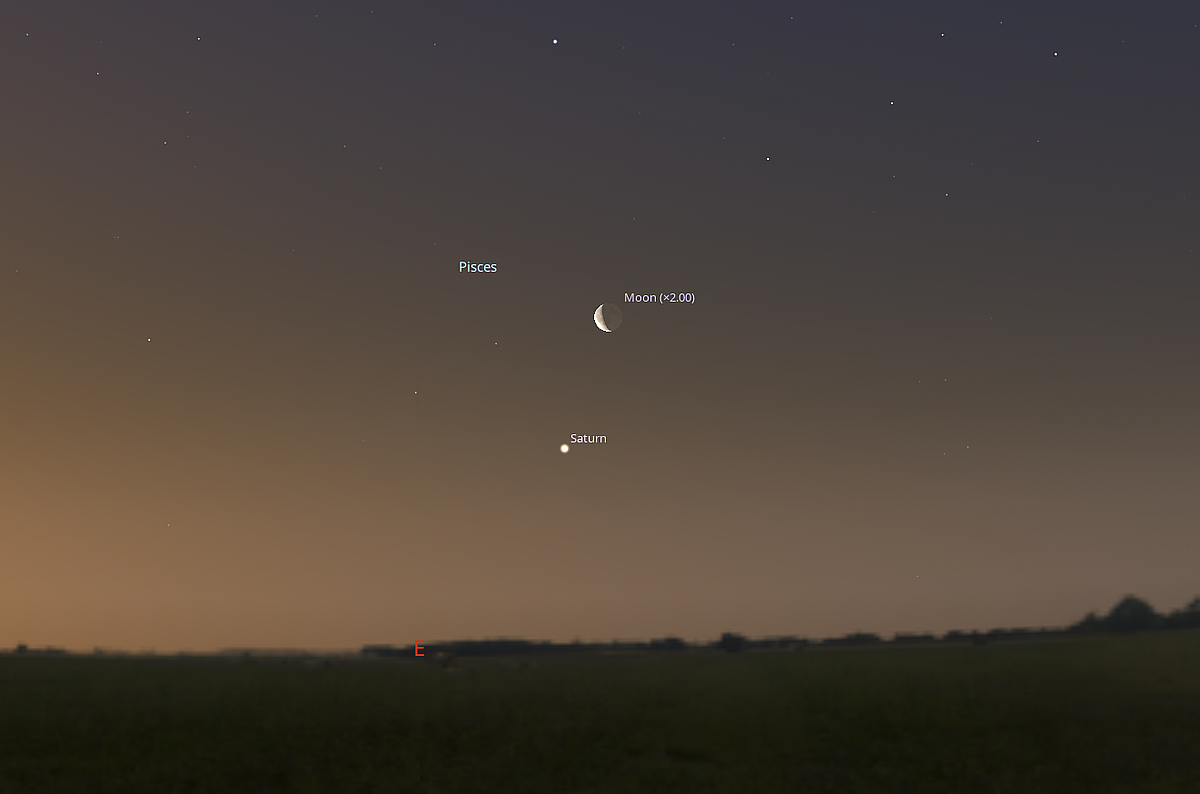
June 10th around 03:15hrs BST - Saturn and waning Moon.
(Click for full image)
Saturn's ring system is now starting to open once again but are still shallow around 5 degrees. Saturn's largest moon, Titan, should be visible as a speck of light nearby.
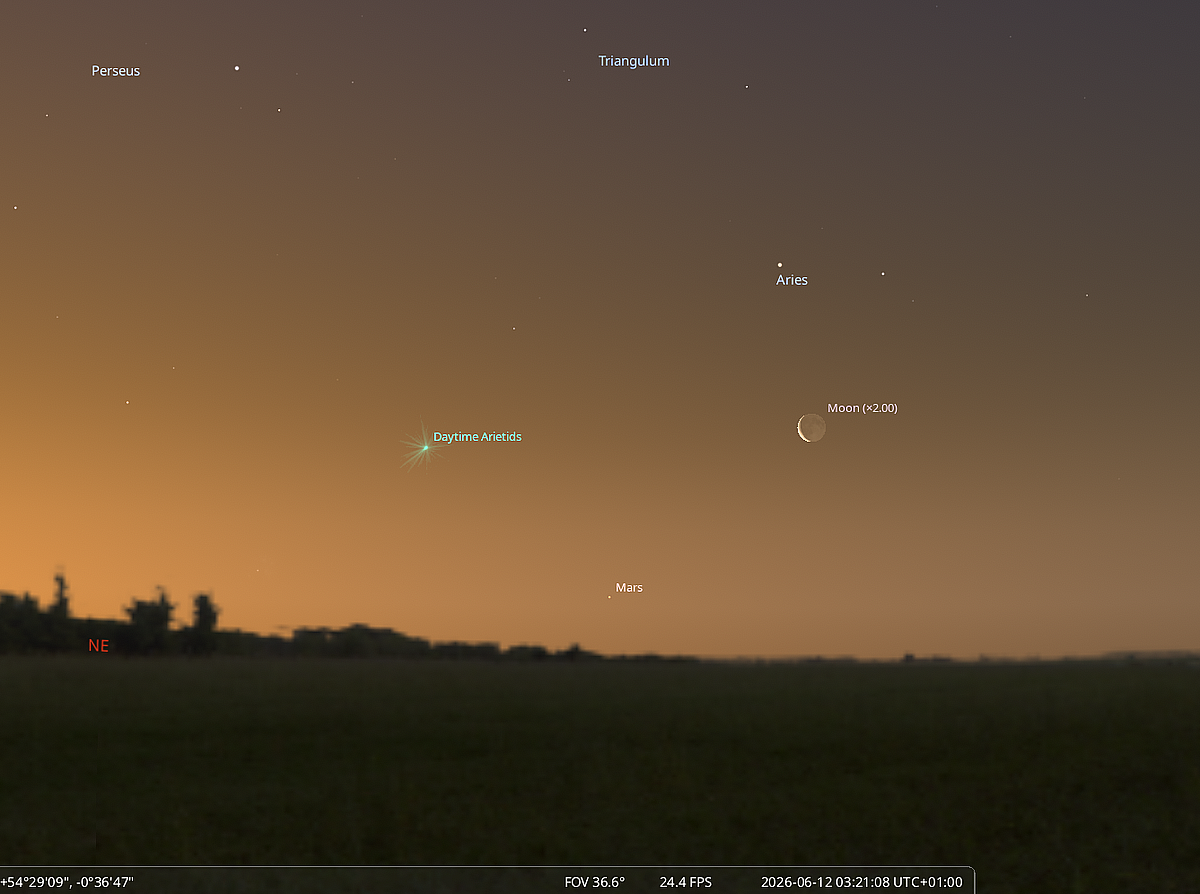
 Mars is a difficult object low in the dawn sky across in the NNE. The red planet is far from being conspicuous (mag +1.5 only), the short observing window and brightening twilight factors in making this challenging. Binoculars will certainly help with this task. On June 12th Mars lies lower left of a waning crescent Moon a few degrees above the NNE horizon. View around 03:00-03:25hrs.
By the end of the month Mars has crept a little higher into the sky and lies 3 degrees below the Pleiades star cluster and less than 2 degrees right of very faint Uranus. Telescopically, there is currently little to view on Mars, a tiny amber disk less than 5 arcseconds across, growing only marginally by the end of summer, Mars not reaching opposition until late February next year.
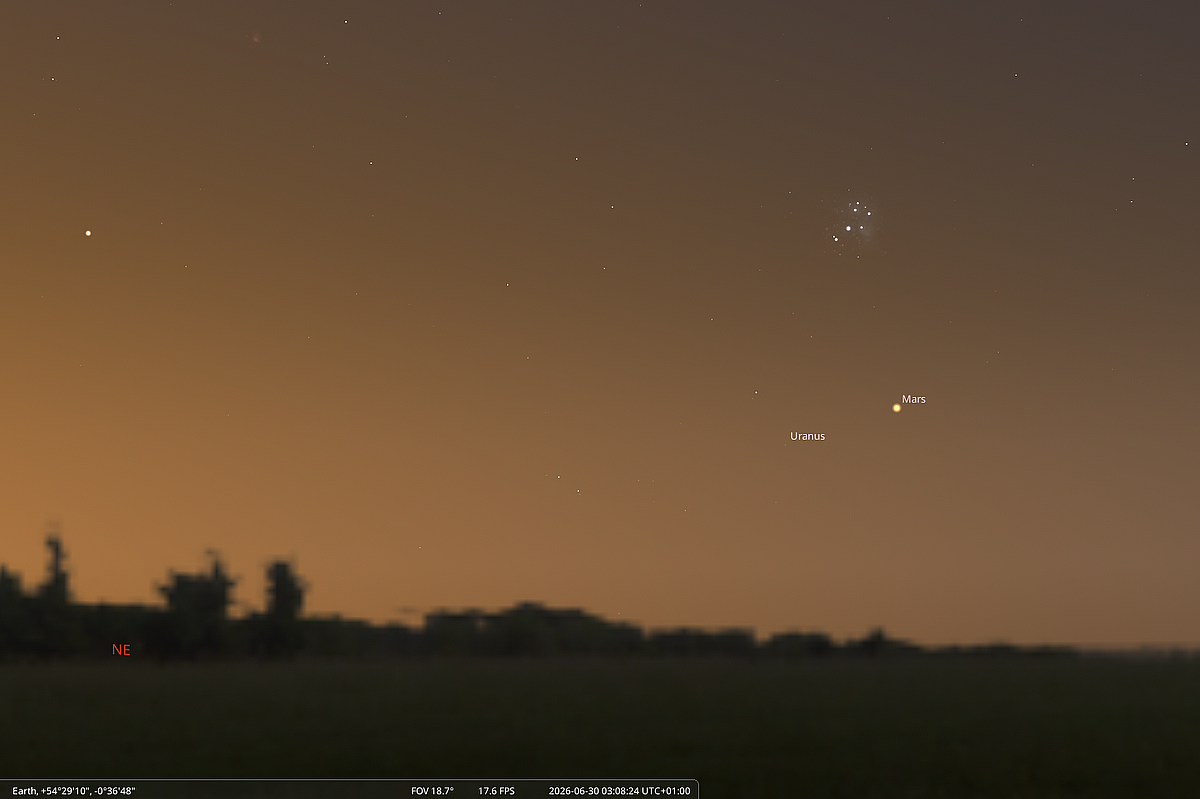
Mars and Uranus below Pleiades - June 30th, 03:10hrs. (Click for full image)
June Meteors, Noctilucent Cloud & T Corona Borealis Watch
Meteor activity is sparse throughout June with no well-defined meteor showers. This apparent low level of activity is due to several reasons, the short, light, nights being one. The ecliptic is also low to the south as seen from the UK at this time of year and is the chief source of any low-level meteor activity. Finally, the minor showers that are apparent yield only a handful of meteors at best.
The Ophiuchids, the radiant of which lies near Theta Ophiuchi approximately 15 degrees east of Antares, may produce a handful of meteors per hour having peaks on June 9th and 19th.
The Beta Taurids are associated with debris left by Comet P/Encke, unfortunately the shower occurs during daylight hours throughout June – Taurus being a winter constellation. This is a pity as radio detection methods indicate the shower is one of the strongest 'radio meteor showers' of the year.
The Alpha Cygnids yields just a few meteors per hour near the end of June. The radiant lies close to Deneb, which is at least high in the NE sky!
Noctilucent Cloud - June Peak
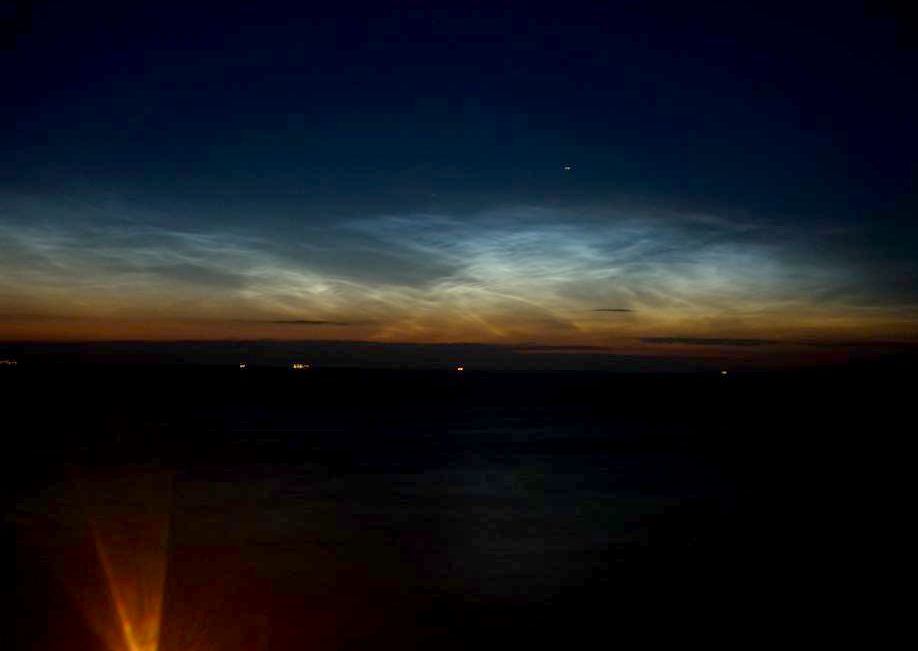
Noctilucent cloud - July 2020. Image Richard Randle from Ralf's Cross.
There have been no significant sightings of noctilucent cloud from the Whitby area so far this year, however June offers up the best chance, with the peak of the noctilucent cloud season normally falling between mid-June to mid-July. This rather beautiful type of cloud formation only forms during the summer months above the northern horizon long after sunset, often around midnight. Its appearance is quite distinct, shining quite brightly, exhibiting a characteristic silvery-blue hue and filamentary in structure. It forms exclusively between latitudes 50 and 60 degrees north, at an altitude of over 50 miles, five times higher than normal clouds. The cloud forms when water vapour condenses at the low temperatures that prevail at such altitudes onto particles suspended in the air. Most certainly keep an eye out to the north as twilight deepens.
T Corona Borealis
And finally, the wait continues for the recurrent nova T Corona Borealis to erupt with astronomers across the northern hemisphere keeping a close watch this month. Speculative predictions suggest the outburst could occur at the next 228-day perihelion orbital passage, which is due on June 25th. There is also another in February 2027. Corona Borealis is at least well placed for UK observers currently, high to the south as twilight deepens. The downside being it will be 23:30hrs for twilight to be deep enough to spot T CrB. Keep checking and stay abreast of the media.
The Summer Solstice
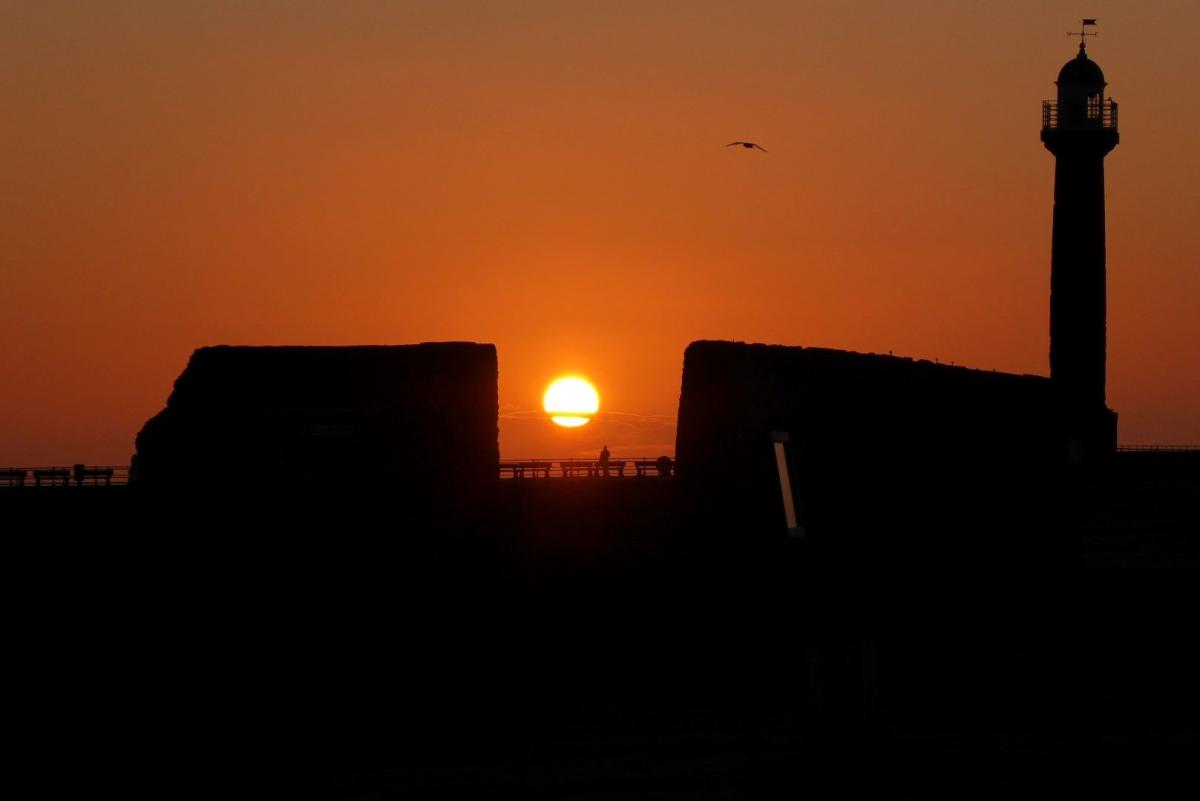
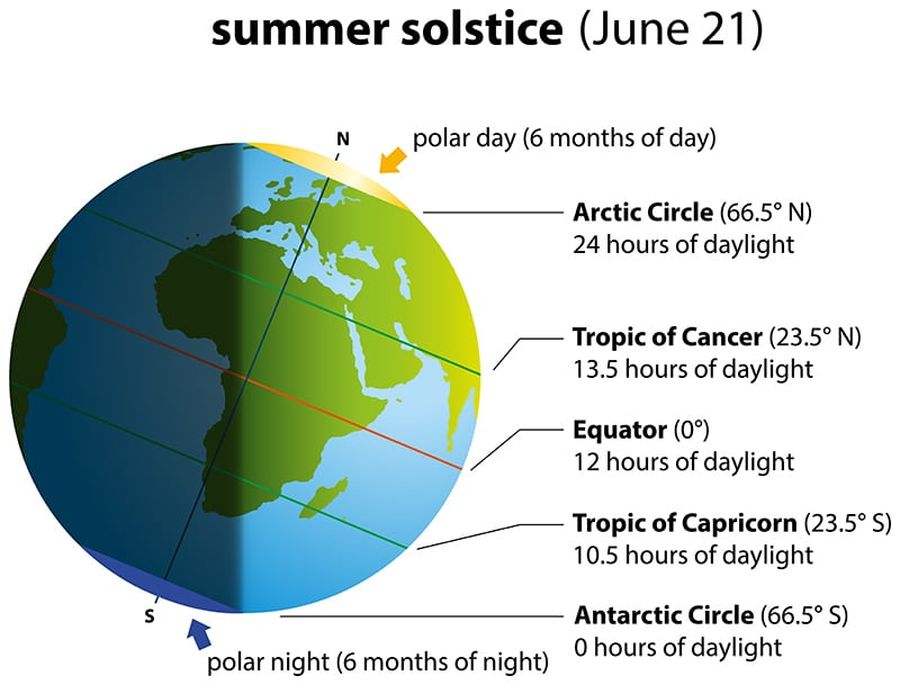
The summer solstice in the northern hemisphere occurs on June 21st this year, when the Sun reaches its highest point in the sky along the ecliptic—the path it takes across the sky throughout the year. The term "solstice" originates from the Latin word’s sol (meaning "Sun") and sistere (meaning "to come to a stop or stand still"). On the day of the June solstice, the Sun attains its northernmost position as observed from the northern hemisphere of Earth, remaining stationary at the Tropic of Cancer. Subsequently, the Sun reverses direction and begins moving southward. The opposite phenomenon occurs during the December solstice, when the Sun reaches its southernmost position corresponding to the Tropic of Capricorn.
It is a common misconception that Earth is closer to the Sun during this time of year; however, the reality is quite the contrary. Earth is farthest from the Sun on July 6th this year, at 152 million Km or nearly 95 million miles, approximately 3 million miles farther than its closest approach in early January. The warmth experienced during this period is due to the inclination of the northern hemisphere towards the Sun, resulting in a higher concentration of sunlight per unit area. This effect can be likened to a spotlight directed at the palm of one's hand, where direct radiation causes increased warmth, whereas a tilted angle reduces heat intensity. In June, the intensity of solar radiation is on average equivalent to approximately 1.2KW per square metre on the surface, but this depends strongly on Sun angle, atmosphere and cloud.
The summer solstice is currently located at the border of the Gemini and Taurus constellations. However, this was not always the case. Thousands of years ago, the summer solstice was observed in front of the stars of Cancer in the northern hemisphere, but because of precession—Earth’s gradual axial wobble—it has shifted over time.
At our latitude, we never see the Sun directly overhead. However, within latitudes 23.5 degrees North and 23.5 degrees South, the Sun can appear directly overhead, casting no shadows. This phenomenon was noted by astronomers in antiquity. The term "Tropic of Cancer" originated because, at that time, the summer solstice occurred in front of the stars of the Cancer constellation. Similarly, when the Sun was positioned before the stars of Capricorn at its southernmost limit on the ecliptic (during the winter solstice), 23.5 degrees south of the celestial equator, it led to the naming of the "Tropic of Capricorn."
Astronomers denote the June solstice as the commencement of summer in the Northern Hemisphere, while meteorologists recognize the season's beginning almost three weeks earlier, on June 1. Despite being labelled the longest day, the earliest sunrise and latest sunset do not coincide with the date of the summer solstice. In Whitby, for example, the earliest sunrise occurs around June 16 at 04:25 hrs, and the latest sunset takes place on June 25 at 21:42 hrs. The duration of usable daylight reaches its peak on June 21, totalling just over 17 hours, which results in approximately 4 hours of semi-darkness. Whilst June 21 is normally regarded as the date of the June solstice, it can occur anytime between June 20 and June 22. Solstices on June 22 are infrequent; the last occurrence was in 1975, and the next will not take place until 2203.
June Night Sky
The start of astronomical summer commences on June 21st in the northern hemisphere, the short, light, nights severely impacting observational astronomy from UK latitudes. Deep sky observing is confined to a post-midnight window of only a few hours, hampered further by the lack of truly dark astronomical twilight, rendering fainter deep sky objects invisible.
Casual stargazing pre-midnight is also limited, naked eye stars fainter than magnitude +3 concealed in nautical twilight making constellation recognition challenging. Safe to say then that as far as observing goes the upcoming months are reserved for the highly dedicated or the insomniac.
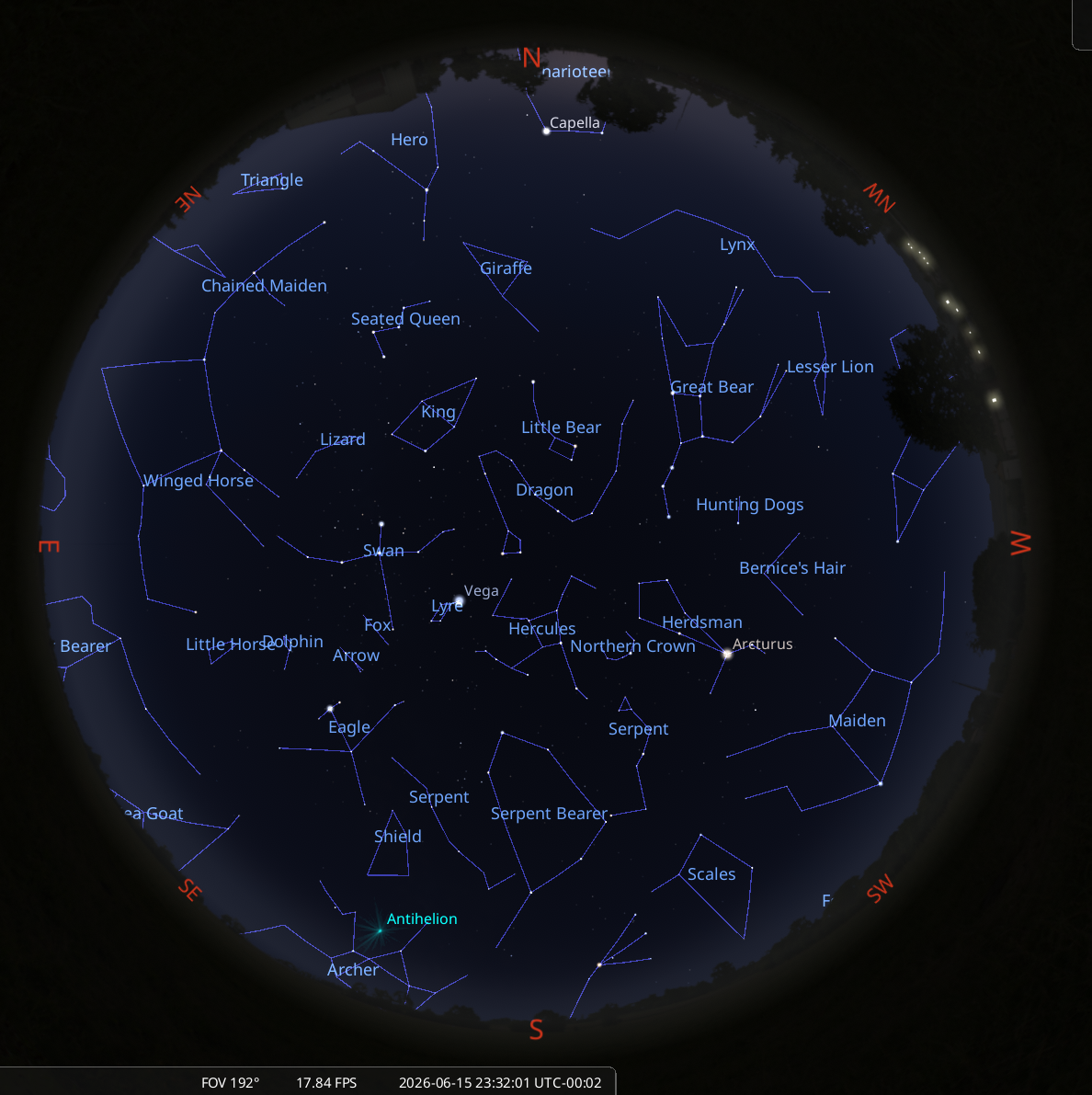
June night sky - around 23:00hrs BST. (Click for full image)
Gazing up at the sky around 22:30hrs, just a few isolated stars are visible in the lingering twilight. The first star typically noticeable is Vega located high in the east-northeast in the small lozenge shaped constellation of Lyra. At magnitude 0.01, Vega is the third brightest star visible from UK shores and the most prominent member of the "summer triangle" asterism. Vega is relatively nearby by stellar standards - just 26 light years away, its steely blue light particularly striking when observed through binoculars or a telescope.
Estimated to be just 450 million years old, Vega is only masquerading as a younger star, already reaching middle age. This relatively short lifespan is a result of Vega being twice the mass of our Sun. Vega is believed to possess a proto-planetary disk, potentially capable of supporting planets but not necessarily life.
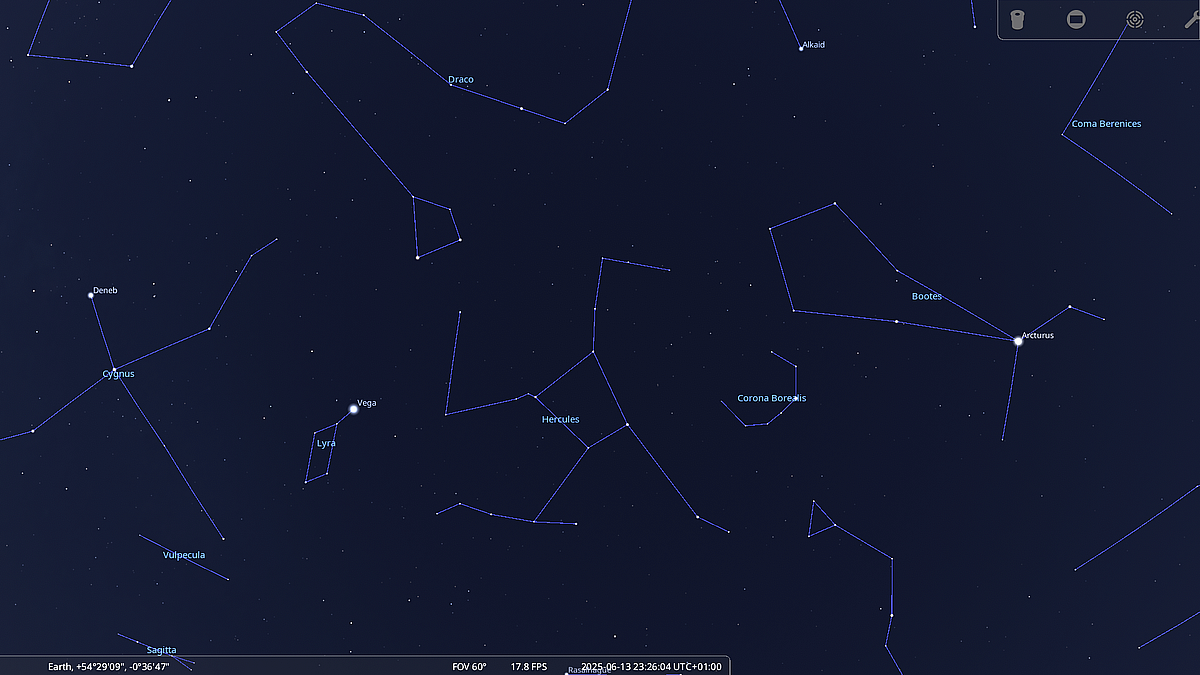
Vega and Arcturus - Jewels in the summer sky. (Click for full image)
Competing with Vega to be "first star visible", Arcturus is marginally brighter in apparent magnitude (-0.01), but over the summer months is often beaten to it, being in brighter skies high to the SSE. Classified as a K-type orange giant, Arcturus (or Alpha Boötes) is estimated to be approximately 750 million years older than our Sun. It is situated about 37 light-years away and possesses one of the largest proper motions (genuine stellar movement) of any bright star, traversing the Sun's path as it orbits the Milky Way galaxy. In fewer than half a million years, a telescope will be necessary to observe it at all.
Adjacent to Boötes lies the recognizable circlet of stars denoting Corona Borealis, the Northern Crown. The central star in this constellation, Alpha Coronae, known as Alphecca or Gemma, is relatively prominent with a magnitude of +2. Should you notice another similarly bright star lower left of this star, do a little celebratory dance as it indicates that the recurrent nova T Cor B has erupted, an event occurring roughly every 80 years and currently overdue. (Refer to sky notes January 2025)
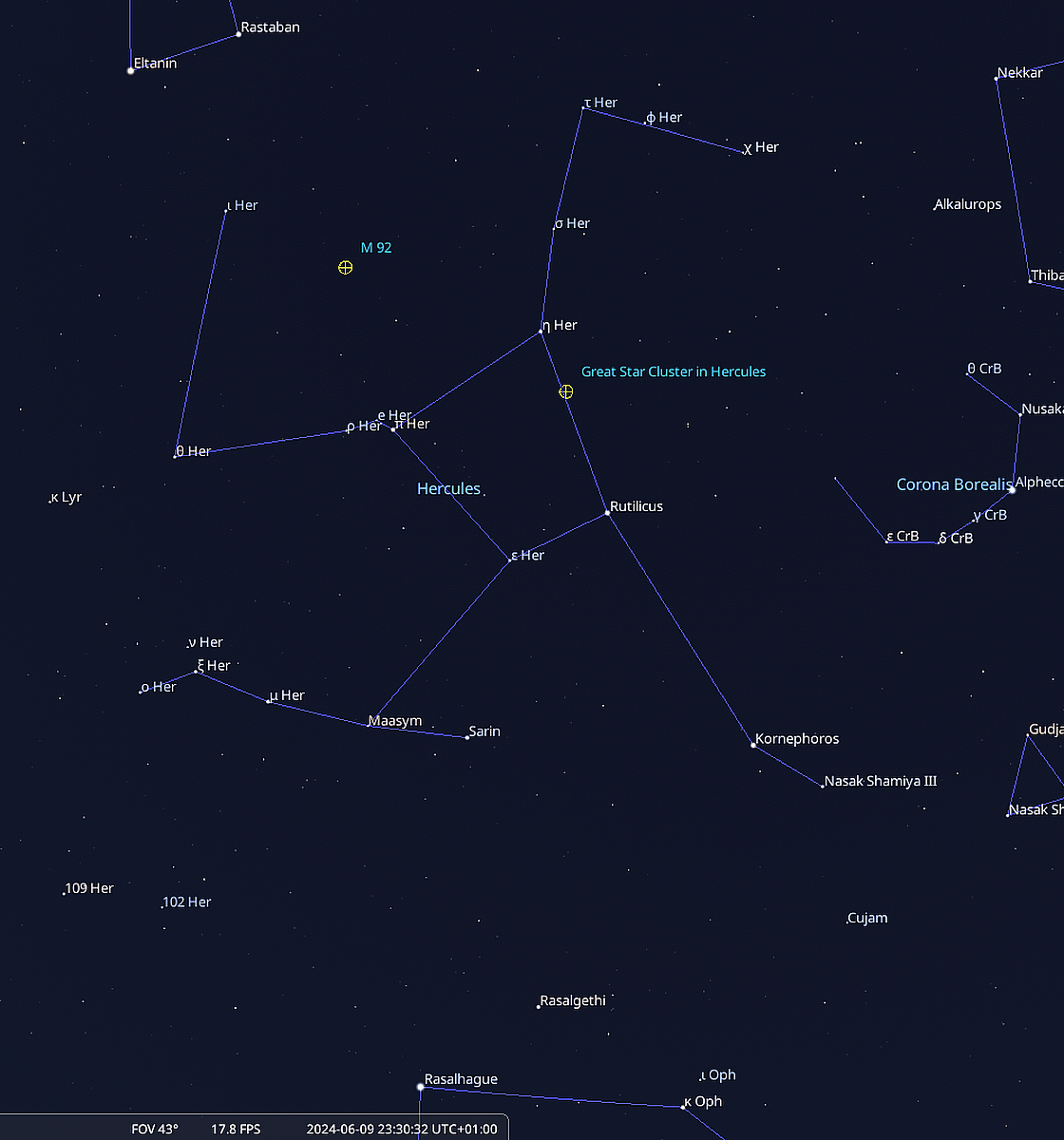
Hercules - stars and Messier deep sky objects. (Click for full image)
High to the south - upper left of Corona, resides the fifth-largest constellation: Hercules. Given its status, Hercules is a relatively faint constellation being the largest of the 50 constellations that do not contain any stars brighter than magnitude +2.5. It is best identified by the "keystone" asterism marking the central hub of the group. All four stars within this arrangement are not particularly conspicuous, Zeta Herculis or Rutilicus, residing at the bottom right of the arrangement being the brightest at mag +2.85.
The brightest member of Hercules; Beta Heculis or Kornephoros (mag +2.75) is located some distance below Rutilicus. Alpha Herculis or Rasalgethi, meaning "Head of the Kneeler" in Arabic, is slightly fainter (mag +3) and is a triple star with the primary component being approximately 400 times the diameter of the Sun. While Hercules may lack bright stars, it contains two notable deep sky objects: M13 - the great globular cluster, considered one of the finest of its type in the northern hemisphere and M92, another pleasing globular cluster worth tracking down, often overlooked due to the prominence of M13.
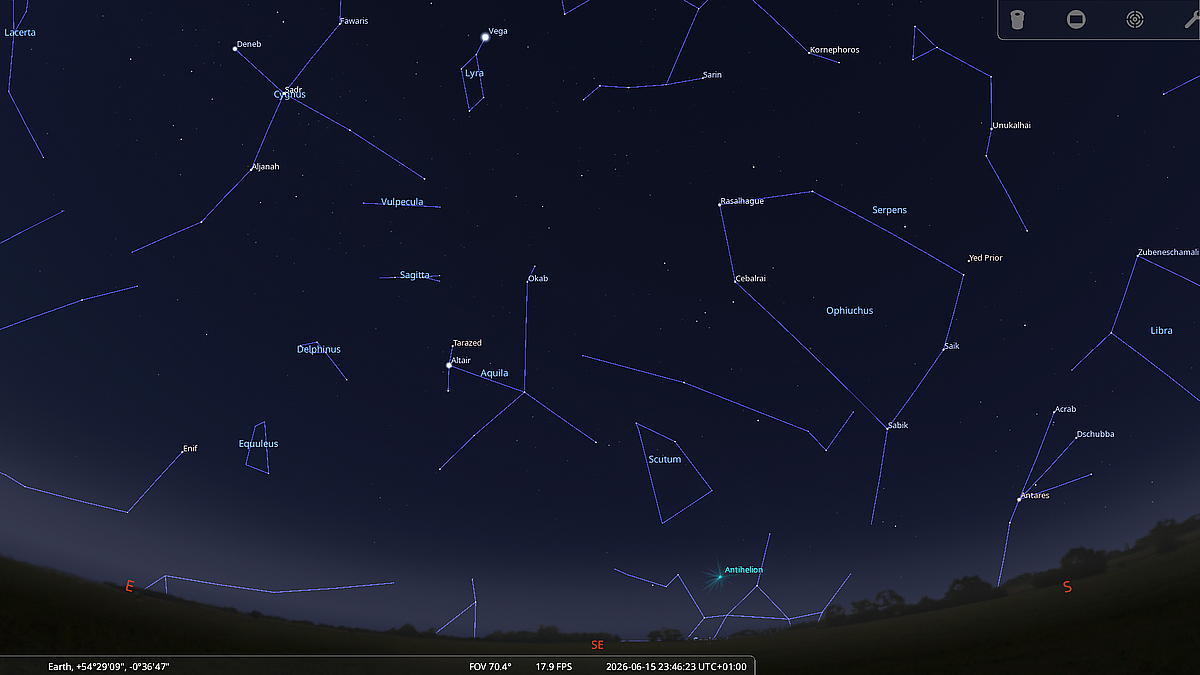
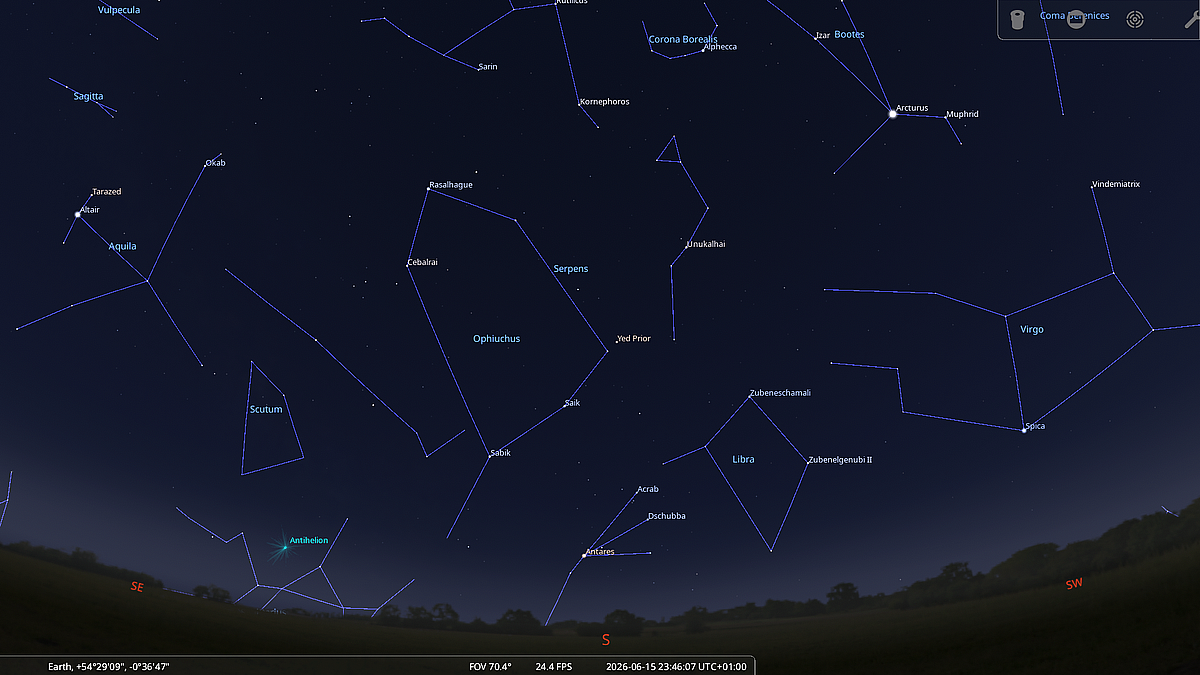
The lower reaches of the southeast aspect centred on Ophiuchus. (Click for full map)
Below Hercules lies Ophiuchus, another large but faint constellation, extending down to the northern border of Scorpius. Ophiuchus - the Serpent Bearer, is the 11th largest constellation in the sky, containing just five stars brighter than magnitude +3. Its brightest star, Rasalhague ('head of the serpent charmer'), has an apparent magnitude of +2.07. Rasalhague is situated at the apex of the 'roof' that sits atop the 'hay barn gable end' outline of stars that form the main body of Ophiuchus. It is positioned to the left and below Ras Algethi in Hercules, resulting in the alpha stars of these two large constellations appearing relatively close to each other in the night sky.
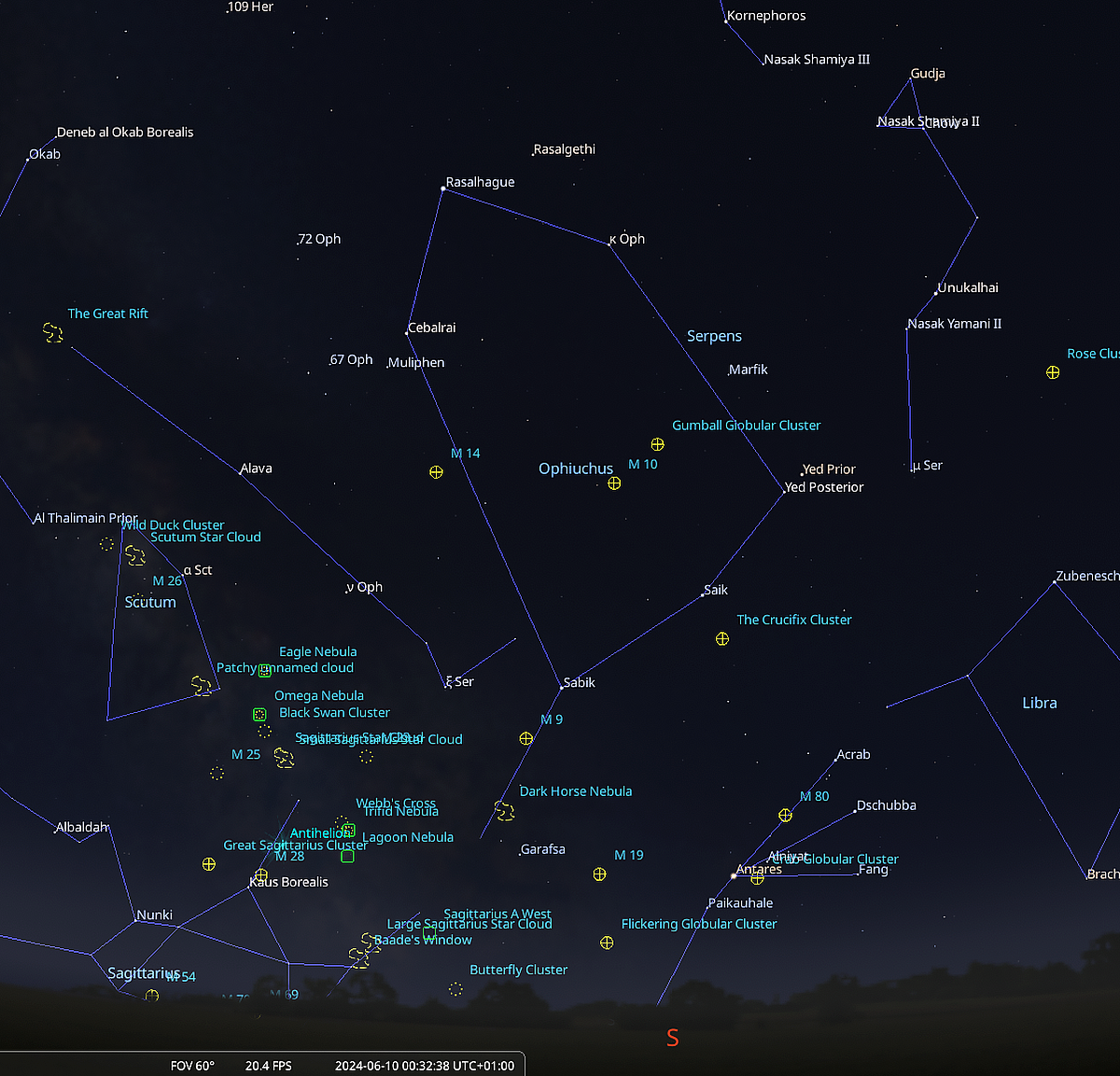
Ophiuchus - stars and Messier deep sky objects. (Click for full image)
Ophiuchus contains many deep sky objects (DSO's) including seven Messier objects; M9, M10, M12, M14, M19, M62 & M107, all of which are globular clusters. Ophiuchus also currently contains Barnard's Star, which at 5.96 light years is the nearest star to the Sun after the three components of the Alpha Centauri system, making it the closest star north of the celestial equator. At mag +9.5 it requires binoculars to spot it and lies to the left of Beta Ophiuchi (Cebalria).
Looking to the ESE, the bright star rising into the eastern aspect is Altair, chief star in the constellation of Aquila, the Eagle. Altair is the nearest of the prominent summer stars visible from the UK, located only 16 light-years away. Altair marks the southerly point of the "summer triangle" and is the only member of the asterism to set. It has an apparent magnitude of +0.77.
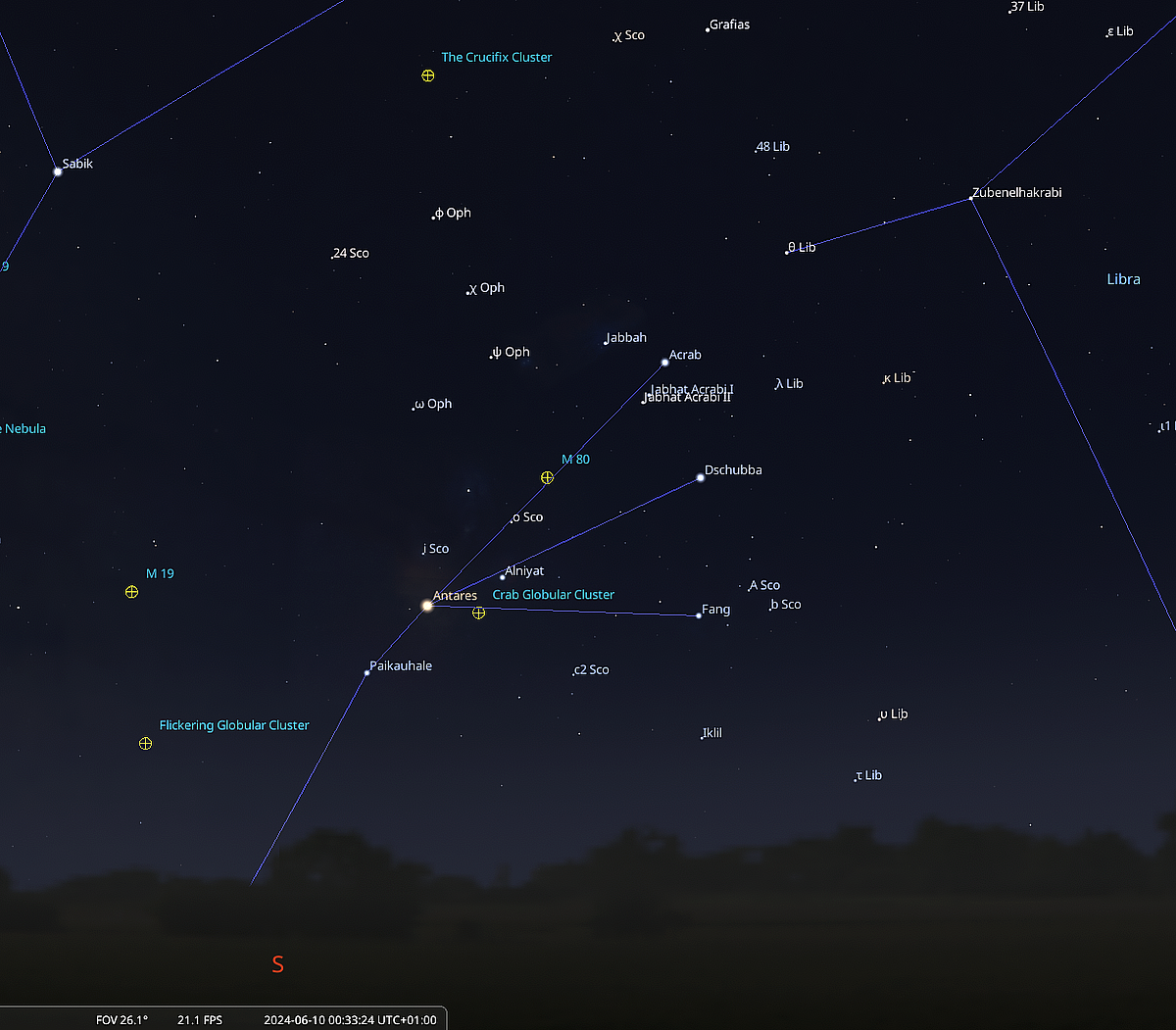
Scorpius - stars and Messier deep sky objects. (Click for full image)
Continuing down the spine of the southern aspect of the sky, among those constellations visible before midnight, we arrive at Scorpius straddling the southern horizon. It is a great pity that from UK shores Scorpius never fully rises, being one constellation that really does resemble the creature it represents - a Scorpion. From UK latitudes, the tail and 'sting' stars remain below the horizon. Scorpius's chief star, the 1st magnitude M class star Antares, is one of the most orange stars visible, a pulsing red supergiant varying in magnitude between +0.88 and +1.16 and a potential supernova candidate. The star is upwards of 380 million miles in diameter and lies approximately 550 light-years away.
Unlike the previous two constellations with only a few stars brighter than mag +3, Scorpius contains 13 such stars, although many are hidden or shrouded in haze from UK latitudes.
With the Milky Way passing through Scorpius, numerous deep-sky objects are located within its borders, including 4 Messier objects: M4, M6, M7, and M80. The first and last are globular clusters, while M6 and M7 are galactic open clusters. M4 can be found to the right of Antares, while M6 and M7 barely rise from the UK's shores. The optimal time to observe these being late June, 23:30-00:15hrs, just a few degrees above a flat southern horizon.
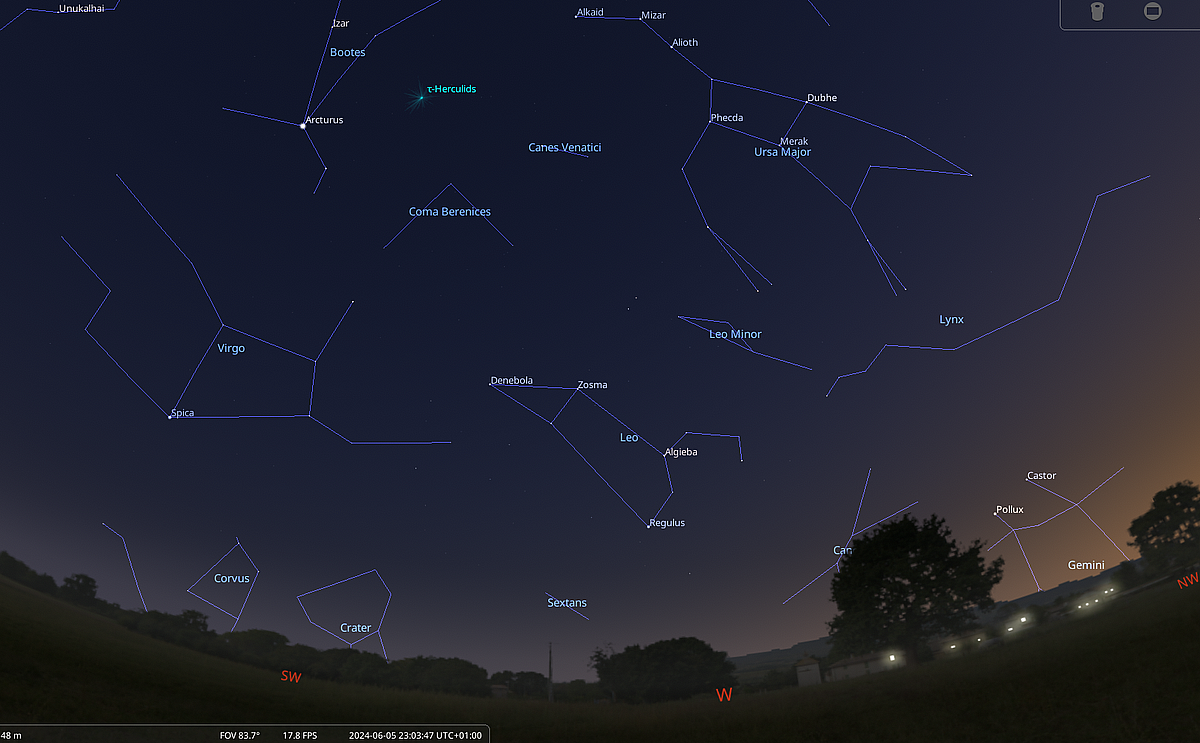
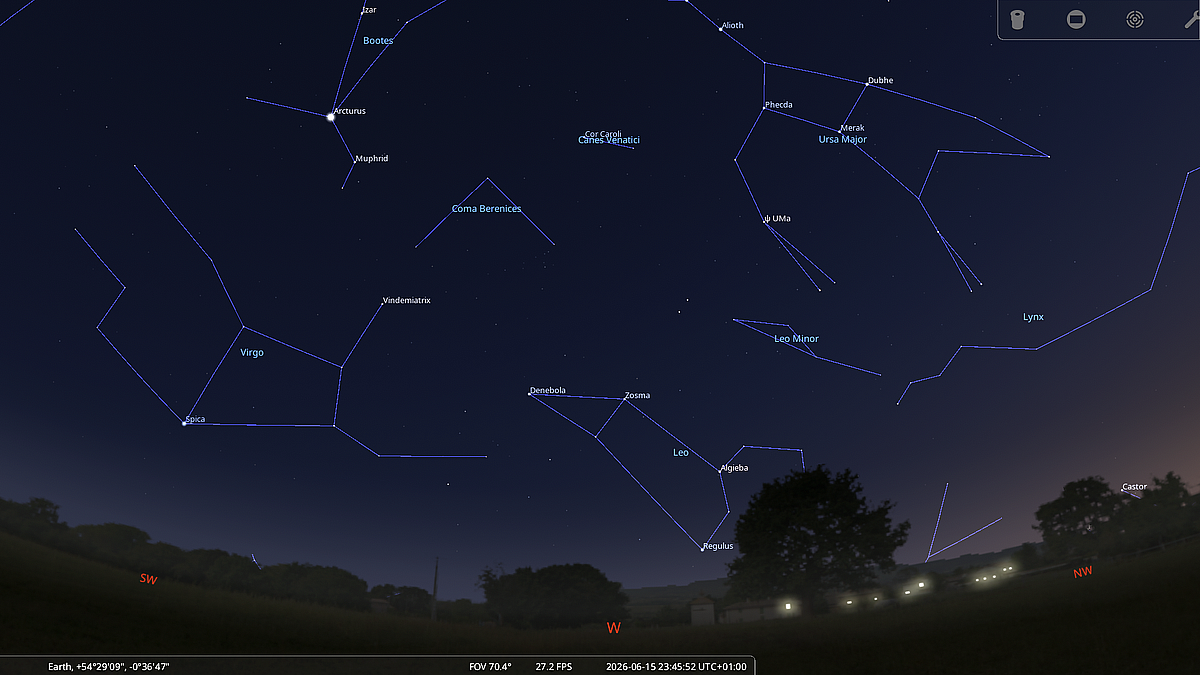
The western aspect of the June night sky - 23:00hrs. (Click for full image)
Aside from those constellations already discussed above, what about the rest of the early summer sky? Surprisingly, a portion of the seasonal winter constellation of Gemini, highlighted by Castor and Pollux remains above the NW horizon for early June, the twins finally succumbing by mid-month. The giant Sea Snake of Hydra has mostly slipped below the SW horizon, the remaining portion doing so in early June taking with it the constellations of Corvus and Crater.
Even Leo, the signature group of spring highlighted by Regulus at the foot of the 'sickle' asterism, will be departing by the month's end. Another important spring constellation, Virgo, remains visible low in the WSW for one more month, its lead star Spica, not setting until early July.
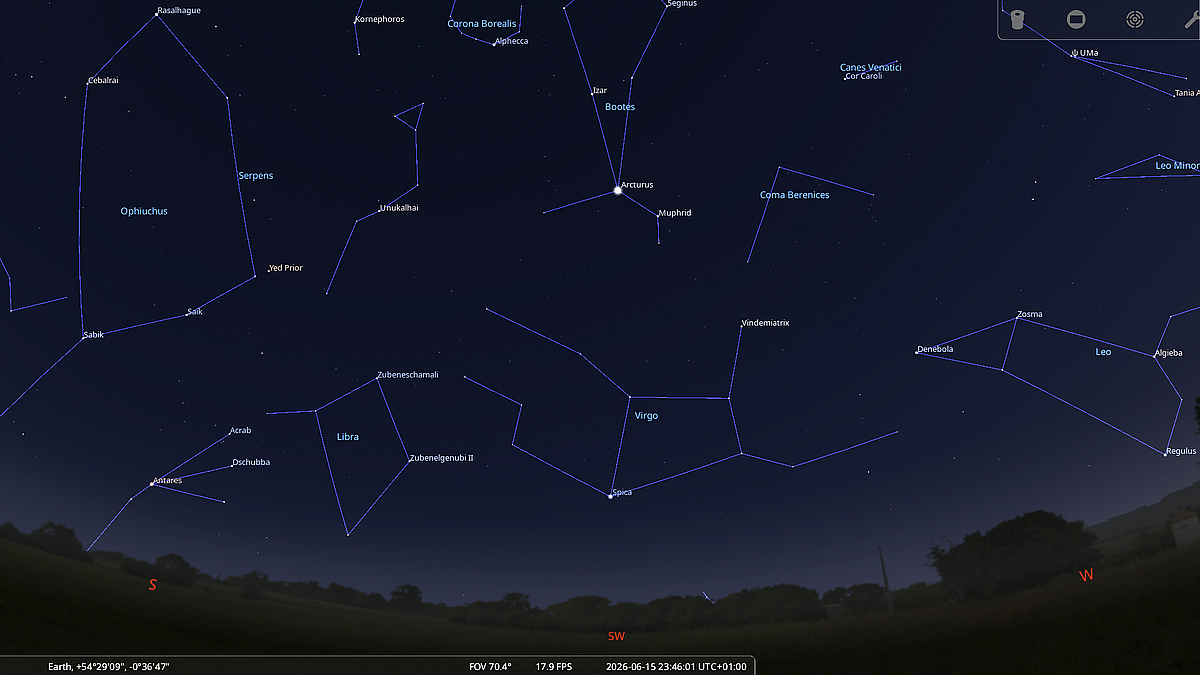
Virgo, the 'sower of seeds' with Spica low in the SW. (Click for full image)
Turn to the north to locate conspicuous Capella chief star in Auriga the Charioteer just above the NNW horizon. Being circumpolar, Capella is often mistaken for the North Star during the summer months as it arcs low down on its endless journey around the pole. Polaris, the true Pole, or North Star stands 54 degrees (Whitby's latitude) due north in the constellation of Ursa Minor and is far less prominent. It can be tracked down using the ‘pointer’ stars in the bowl of the ‘plough’ or ‘big dipper’ asterism in Ursa Major located high to the NW.

Capella skirts the NW horizon. (Click for full image)
Curving up and around the Little Bear are the stars of Draco, the head of the dragon marked by a quadrilateral of fainter stars resting above Hercules. Below Draco high in the northeast, King Cepheus oversees his court. His queen, Cassiopeia, is seated beneath him. The outline of Cassiopeia suggests the letter 'W' or 'M', a distinctive stellar arrangement readily identifiable.
Look below and east of Vega, to locate the least brilliant member of the summer triangle, Deneb, marking the tail of Cygnus the swan. At magnitude 1.25 Deneb is ranked the 19th brightest star in the sky, situated approximately 1700 light years away. This distance conceals Deneb’s true luminosity, estimated to be 80-120 thousand times that of our Sun. As such, Deneb will have a relatively short lifespan estimated to be less than 20 million years, evolving into a vast supergiant star. Ultimately, Deneb will end its life cycle as a spectacular supernova, undoubtedly for astronomers of that time an event of great astronomical significance.

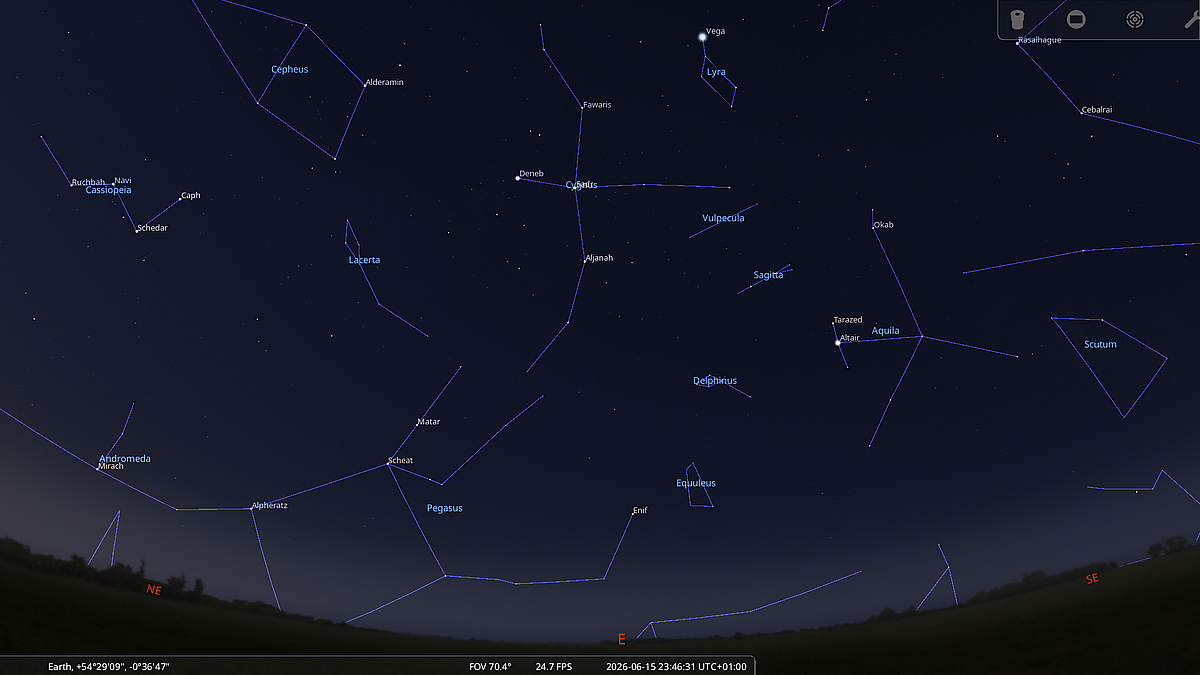
The north-east aspect of the June night sky - 23:30hrs. (Click for full image)
As strange as it may seem, even as we head into astronomical summer, constellations associated with autumn are already emerging over the east horizon later in the month. In the vanguard are the star patterns Pegasus, Andromeda and Perseus, stellar signals of darker nights to come. But that is some way off and for now we must contend with the light nights, as difficult and inconvenient as that may be for observing. Nevertheless, if conditions are conducive, it remains a joy just to step outside late one evening and admire the celestial dome.
June 2026 Sky Charts
 |
 |
|
Looking North
June 15h - 23:45hrs BST |
Looking East |
 |
 |
|
Looking South
June 15th - 23:45hrs BST |
Looking West
June 15th - 23:45hrs BST |
 |
 |
|
Northern Aspect
June 15th - 23:45hrs BST |
Southern Aspect
June 15th - 23:45hrs BST |
 |
|
| Northern Aspect (dawn) June 15th - 02:30hrs BST |
Southern Aspect (dawn) June 15th - 02:30hrs BST |

Chart image Credits:
- Sky Charts: Stellarium Software and Starry Night Pro Plus 8
- Log in to post comments
