
In this month's Sky Notes:
Planetary Skylights: A Brief Guide to October's Night Sky
Saturn reaches opposition and is visible from dusk until dawn. Jupiter and Mars are becoming better early-morning targets, while Uranus and Neptune are visible in the evening but require telescopes for confirmation.
 Saturn reaches opposition on 4 October and is visible throughout the night. It is currently the only naked-eye planet in the evening sky. At the start of October, look for it low in the east shortly after 19:45hrs BST; by late October, after GMT resumes, it will be visible from about 17:00hrs. On the date of opposition, Saturn culminates around 01:15hrs BST, approximately 37 degrees above the southern horizon and clear of the turbulent seeing that has affected observations for nigh on the last decade. Conditions should improve further in the coming years.
Set against the faint stars of the Cetus/Pisces border, below the Square of Pegasus, Saturn is easy to identify at magnitude +0.35. It is impressive through a telescope, although its rings are currently tilted by less than 8 degrees. In steady seeing, this is still sufficient to reveal the Cassini Division. The rings will not reach their maximum tilt until 2032.
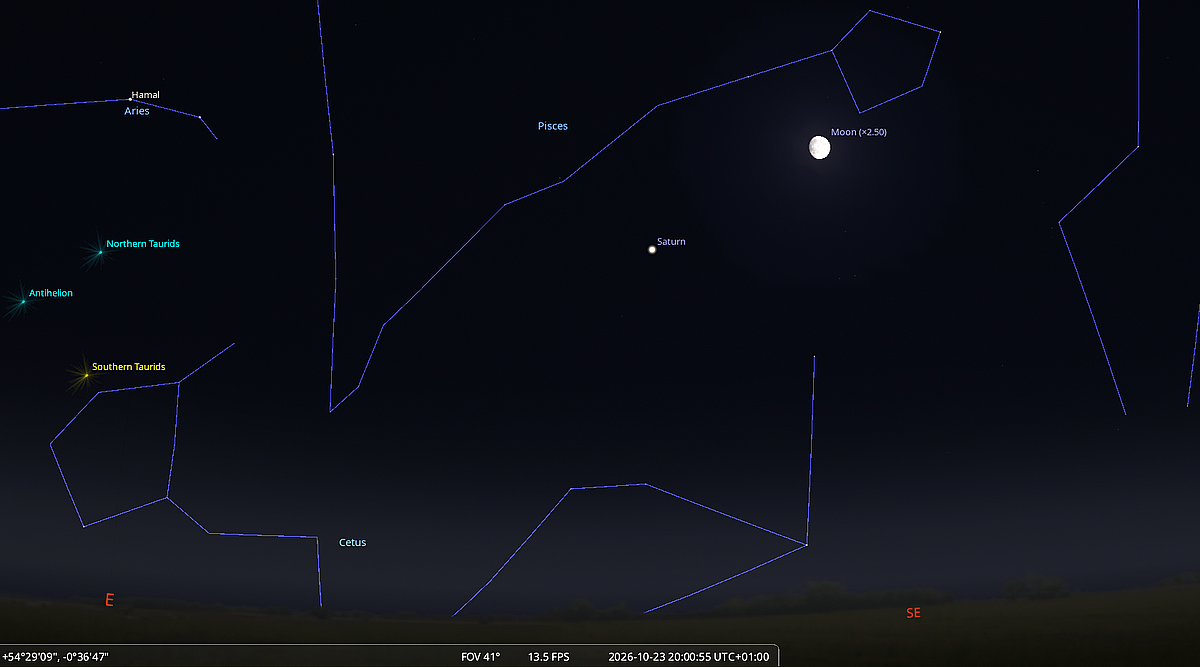
Oct 23rd @ 20:00hrs BST - Saturn and Moon. (Click for larger image)
At opposition, Saturn brightens slightly because of the Seeliger effect, as shadows cast by its ring particles briefly disappear. The effect is stronger when the rings appear more widely open. Titan, Saturn’s largest moon, should be visible as a small point of light near the planet’s disc, completing an orbit about every 16 days. Under dark, steady skies, larger instruments may reveal several other moons. The Moon passes close to Saturn on 23rd and 24th October.
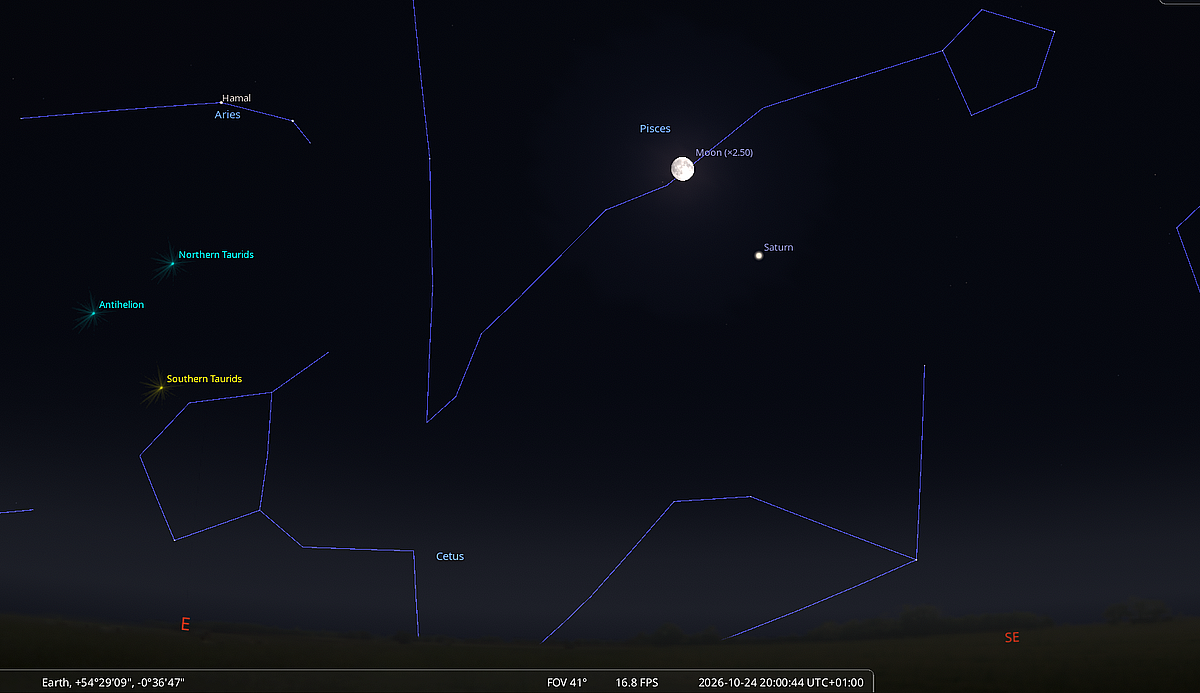
Oct 24th @ 20:00hrs BST - Saturn and Moon. (Click for larger image)
 Neptune reached opposition late last month and is well placed for telescopic observation throughout the night. Located in Pisces, about 8 degrees ahead of Saturn, it shines at magnitude +7.8 and requires an aperture of at least 60 mm (2.5 inches) to spot. Instruments larger than 130 mm (5 inches) show its tiny blue-grey disc, just 2.5 arcseconds across, more clearly. The nearest named stars are 10 Cet and 44 Psc, both about 2.5 degrees east of Neptune.
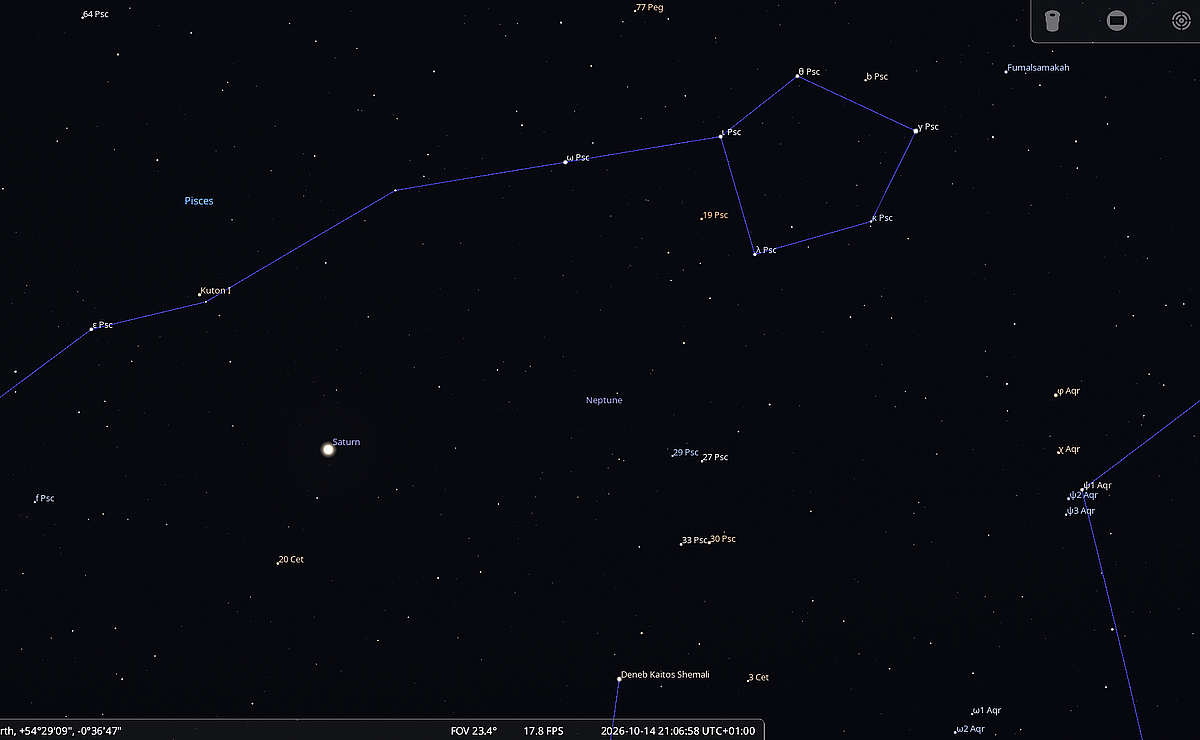
General location chart for Neptune - mid-month. (Click for full image)
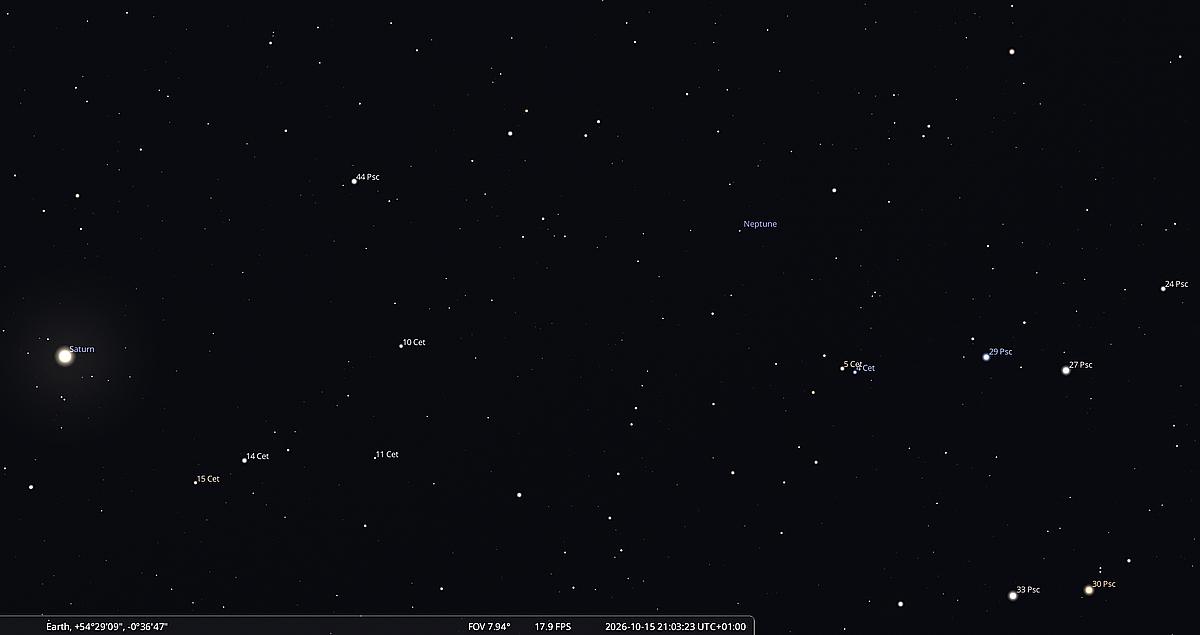
Detailed location chart for Neptune - mid-month. (Click for full image)
 Uranus becomes visible progressively earlier during October: through a telescope from about 21:00hrs BST at the start of the month and 18:00hrs GMT by its end. At magnitude +5.7, it can be spotted with binoculars as a tiny speck if its exact position is known. The general location is situated between the Hyades and Pleiades star clusters in Taurus. An 80 mm (3-inch) telescope will reveal its small, grey-green disc, which spans 3.7 arcseconds; instruments larger than 125 mm (5 inches) show it more clearly.

General location of Uranus, mid-October. (Click for full image)

Detailed location of Uranus, mid-October. (Click for full image)
 Mars remains an early-morning object for most of October, rising before midnight only after the clocks return to GMT near the end of the month. It will become easier to observe as the nights lengthen and it climbs higher. By month’s end, after traversing Cancer, Mars will stand more than 50 degrees above the south-eastern horizon.

Oct 5th, Mars and waning Moon in conjunction @ 02:45hrs. (Click for full image)
By then, Mars will have brightened from magnitude +1.13 to +0.89, while its apparent diameter will have increased by only 0.9 arcseconds to almost 7 arcseconds—still too small for most amateur telescopes to reveal surface detail. On 5th October, Mars will be in conjunction with the waning Moon, with the pair closest at around 05:45hrs BST.
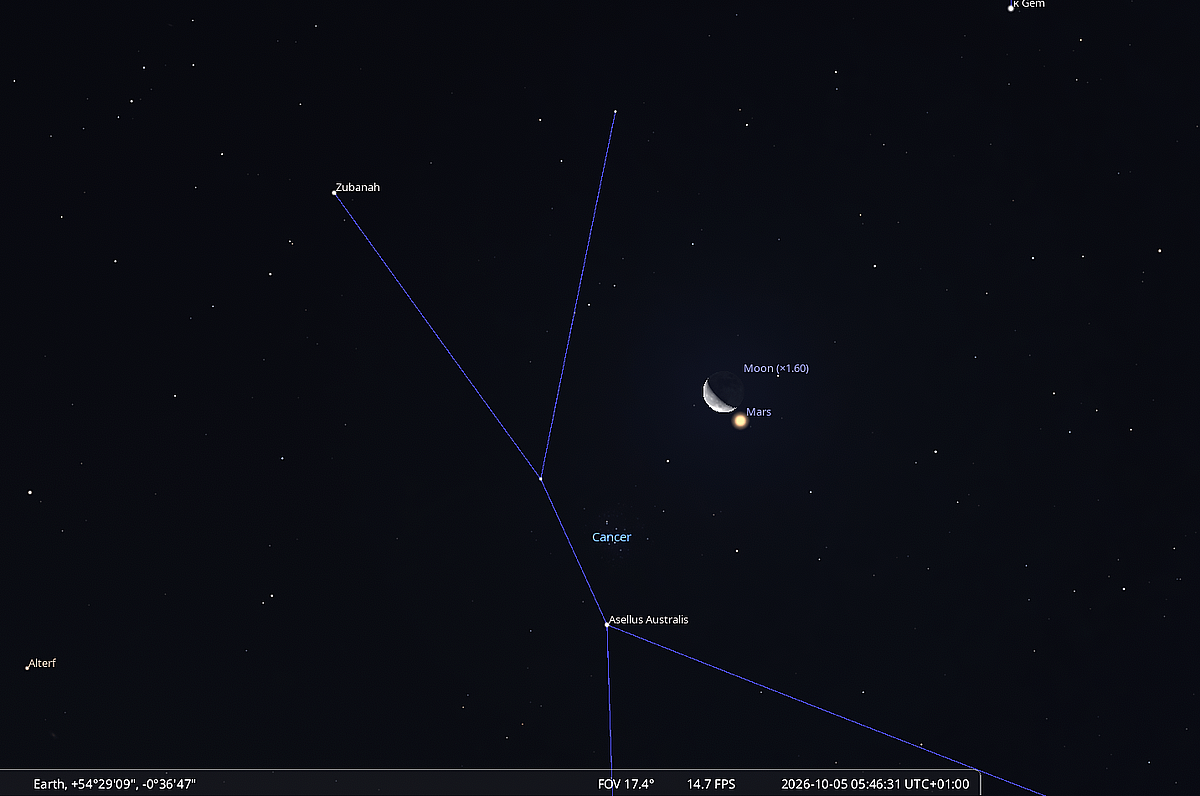
Oct 5th, Mars and waning Moon in conjunction @ 05:45hrs. (Click for full image)
Mars is also closing on Jupiter, ending the month 6 degrees apart, continuing to diminish to around 1 degree by mid-November!
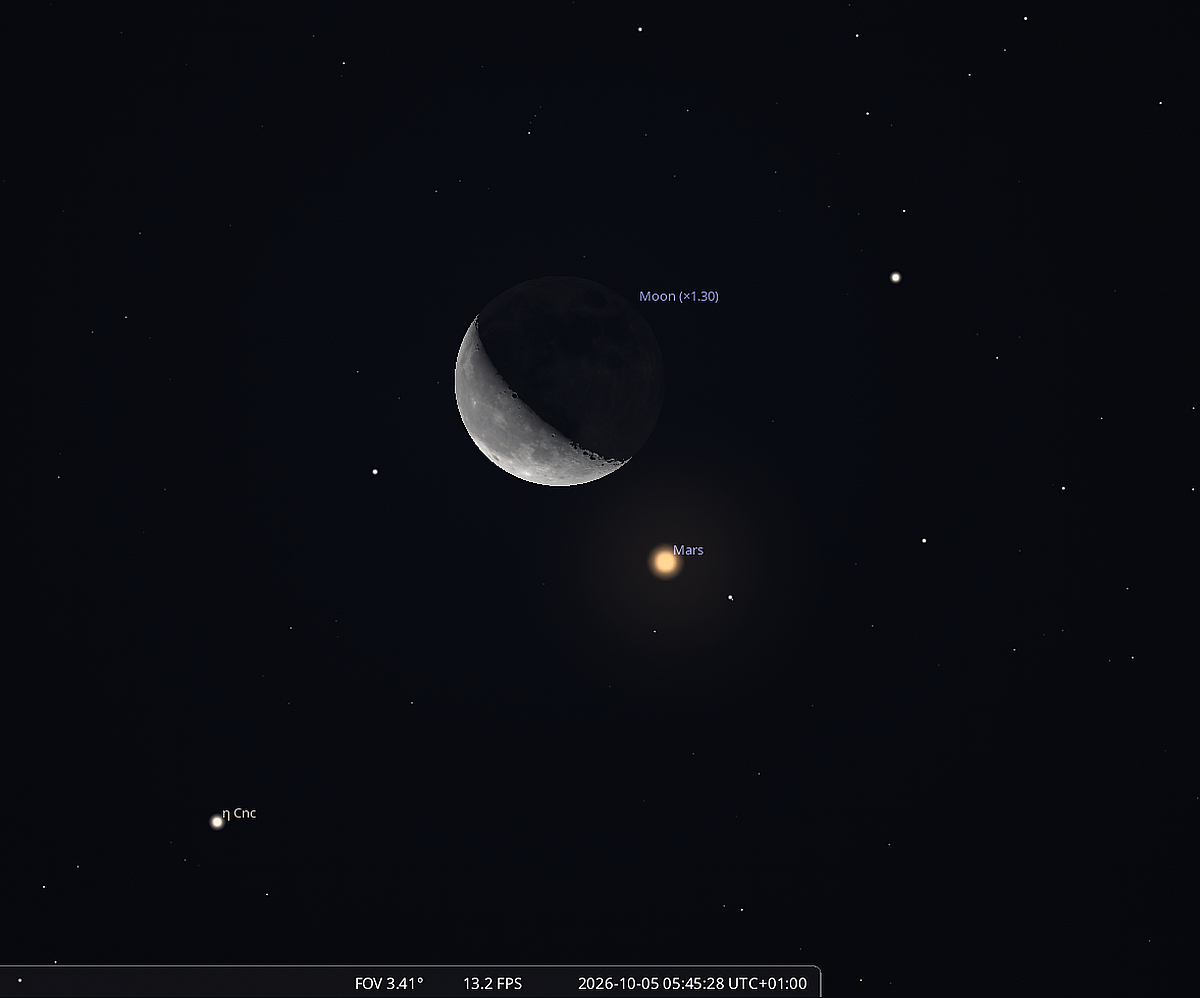
Close up of Mars and Moon on Oct 5th - 05:45hrs.
 Jupiter’s presence in the morning sky continues to grow, visible shortly before 03:00hrs at the start of October and 00:30hrs GMT at the end. Positioned just ahead of Leo’s ‘Sickle’ asterism, Jupiter continues its eastward prograde motion against the background stars, although it is beginning to slow. At magnitude −2.0, it is the brightest object in the overnight sky, despite opposition occuring February 2027.

Oct 6th, Jupiter & waning crescent Moon. (Click for larger image)
Jupiter becomes increasingly impressive through October and is rewarding in any optical instrument. Its noticeably oblate disc spans 37 arcseconds and is clearly visible through the eyepiece. Observers can see its dark atmospheric bands, the Great Red Spot when it faces Earth, and the nearby Galilean moons. The moons orbit Jupiter in days to weeks, while the planet itself rotates in under ten hours.
These rapid movements make Jupiter especially interesting to amateur observers, as the view changes constantly. Larger instruments provide more detailed views of Jupiter’s cloud features, making the Great Red Spot easier to identify and allowing observers to watch moon-shadow transits. The Moon passes near Jupiter on 6th October.
October Meteors

October brings relatively high meteor activity, with three showers reaching their peaks. The Orionids (16–27 October), usually the month’s most prolific shower, peak overnight on 21–22 October. Like May’s Eta Aquariids, they are associated with Comet Halley but favour Northern Hemisphere observers because their radiant is high in the south during the early morning. Prospects are reasonable this year: the waxing gibbous Moon will be low in the west by then.
Orionids are fast-moving meteors that often leave persistent trains. Although the radiant rises at about 22:00 BST, the best chance of seeing them is in the early morning, particularly from 02:30 to 04:30hrs, when the radiant lies around 30 degrees above the eastern horizon.
The Southern Taurids peak on 10th October, with rates only slightly above sporadic levels at about five meteors per hour. Moonlight should not hinder observations this year.
The weak Piscid shower has three peak dates, with 13th October usually the most favourable. Rates are only slightly above sporadic levels, at around three to seven meteors per hour. Piscid meteors are often slow and long-lasting, though rarely bright. Moonlight will not interfere on the 13th.
Perhaps the most interesting shower is the Giacobinids, or Draconids (6–10 October), associated with the periodic comet Giacobini–Zinner, which has a six-year orbit. This highly variable shower usually peaks on 8–9 October but can produce sudden outbursts. Its radiant lies in Draco, high in the north-west between Ursa Major and Ursa Minor. Rates are normally low, at around seven to twelve meteors per hour, but can occasionally exceed 25. Moonlight should not be a problem this year.
October Night Sky

The mid-October night sky - 21:00hrs BST. (Click for larger)
It has become noticeable in recent years that October has increasingly become more akin to September in terms of weather conditions. Should the weather cooperate, the month offers excellent opportunities. As darkness falls in early October, the summer constellations remain well placed. Autumn takes centre stage by mid-evening, and by month’s end the first brilliant seasonal stars of winter are appearing. Add to this, the Milky Way is at its finest.
I remember when I began learning the night sky in October at seven or eight years old, using modest equipment and a few basic astronomy books; it felt like a treasure map revealing its secrets to anyone curious enough to learn.
My first steps into astronomy involved finding one of the best-known star patterns: the Plough, whose dot-to-dot outline resembles a saucepan and is also called the Big Dipper. The Plough is an asterism—a distinctive pattern within the constellation Ursa Major, the Great Bear. Five of its stars are physically associated and share a common proper motion through space. Together with several other stars in the northern sky, they form the Ursa Major moving group.
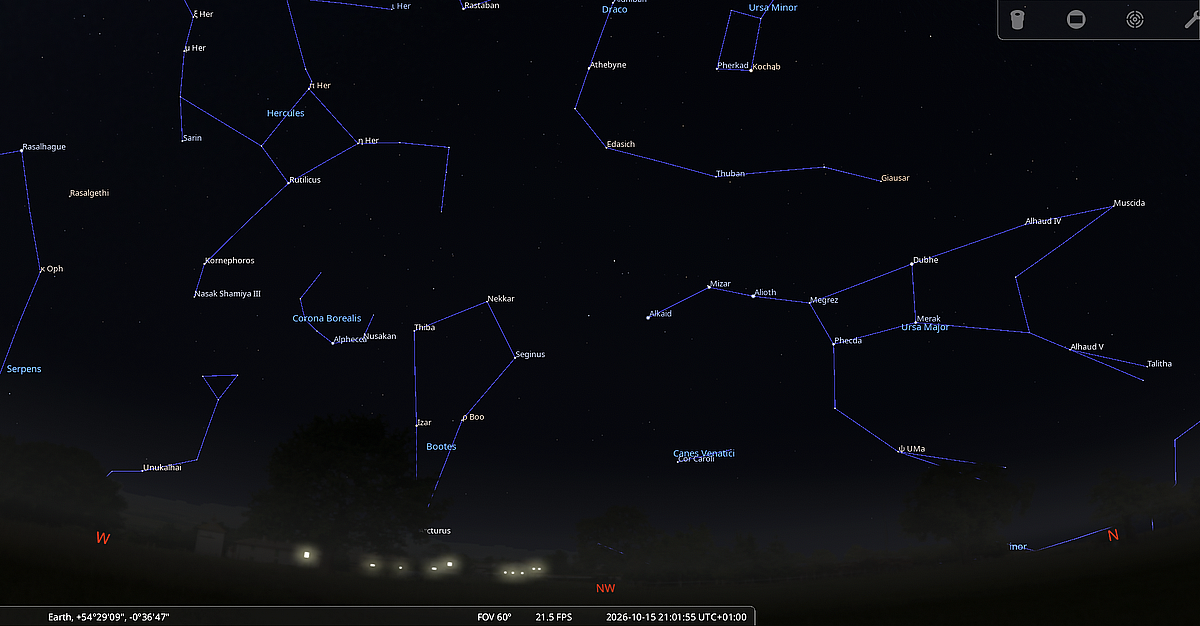
The Northwest aspect of the October night sky - 21:00hrs BST. (Click for larger image)
On autumn evenings, the Plough reaches its lowest point in its continuous circuit around the celestial pole, remaining a couple of hand-spans above the horizon. Look at the middle star in its handle: with good eyesight, you may notice that it appears double. Binoculars clearly separate Mizar and Alcor, while a telescope reveals that Mizar itself is a striking double star. Ursa Major also contains many deep-sky objects, best viewed through a 150 mm (6-inch) telescope. However, the brighter neighbouring galaxies M81 and M82 can be seen even through binoculars as faint smudges of light.
Now, follow the curve of the Plough’s handle to find Arcturus, the brilliant star low in the west-north-west at the base of Boötes the Herdsman. Above and to its left lies the delicate circlet of Corona Borealis, the Northern Crown, with its brightest star, Gemma—also known as Alphecca—set within it. Astronomers worldwide are eagerly awaiting T Coronae Borealis (T CrB), a recurrent nova expected to flare after about 80 years. UK observers are particularly anxious because Corona Borealis is sinking towards the north-western horizon and the eruption of the ‘Blaze Star’ is overdue.

The constellation of Corona Borealis. (Click for full image)

Detailed location chart for T CrB - the Blaze star in Corona Borealis. (Click for full image)
Some distance below the Plough’s handle lies Canes Venatici, the Hunting Dogs, marked by just two stars. The brighter, Cor Caroli—Latin for “Charles’s Heart”—was named in honour of King Charles I. Despite its small size, the constellation contains many deep-sky objects, including the Whirlpool Galaxy (M51), the globular cluster M3, the galaxies M63, M94 and M106, and the Whale Galaxy (NGC 4631).
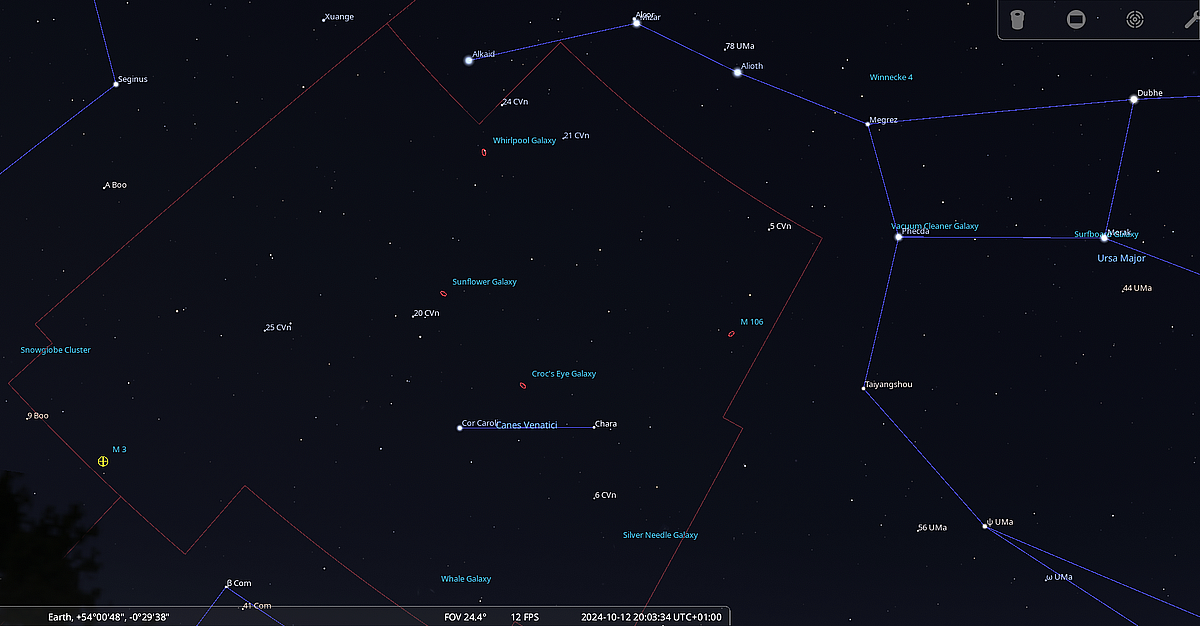
Location of Canes Venatici - the Hunting Dogs. (Click for full image)
Draco, the celestial dragon, winds between the two celestial bears, with its head near Vega. Overhead, the faint outline of Cepheus resembles a crooked house. Although it contains no obvious showpiece objects, it is home to the variable stars Delta and Mu Cephei. Mu Cephei, known as the Garnet Star, is among the reddest stars visible in the sky. Delta Cephei is the prototype of the Cepheid variables: large, luminous yellow stars whose pulsation periods are directly related to their luminosity. This relationship makes them valuable “standard candles” for measuring stellar and galactic distances.
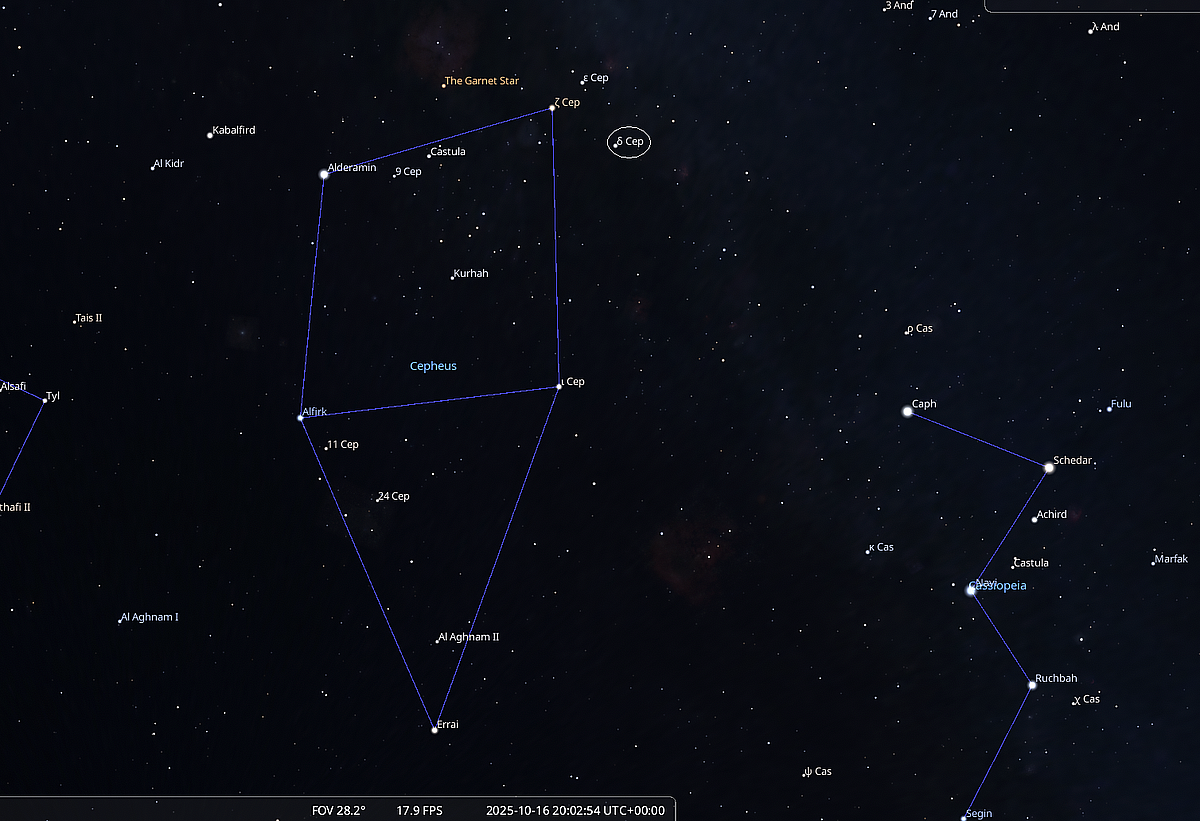
Location of the Garnet star and Delta Cephei in Cepheus. (Click for full image)
Beside Cepheus lies the distinctive constellation Cassiopeia, the Queen, whose outline resembles a ‘W’ or ‘M’. With the Milky Way running through it, Cassiopeia is well worth exploring through binoculars or a telescope.
Following Cassiopeia upwards from the north-east towards the zenith brings you to Perseus, her son-in-law, whose star pattern resembles isobars sweeping across a weather chart.
Beta Persei, better known as Algol, is a fascinating variable star. This eclipsing binary appears to ‘wink’ roughly every three days, earning it the name ‘Demon Star’; more on this next month. Perseus also contains several fine deep-sky objects, notably the Double Cluster, regarded by many amateur astronomers as one of the loveliest sights in a small instrument—a true stellar jewel box!

The Northeast aspect of the October night sky - 21:00hrs BST. (Click for full image)
Beyond Perseus, rising from the north-eastern horizon, is brilliant Capella, the brightest star in the pentagonal outline of Auriga the Charioteer. This circumpolar winter star remains low in the north during summer before climbing overhead as winter begins.
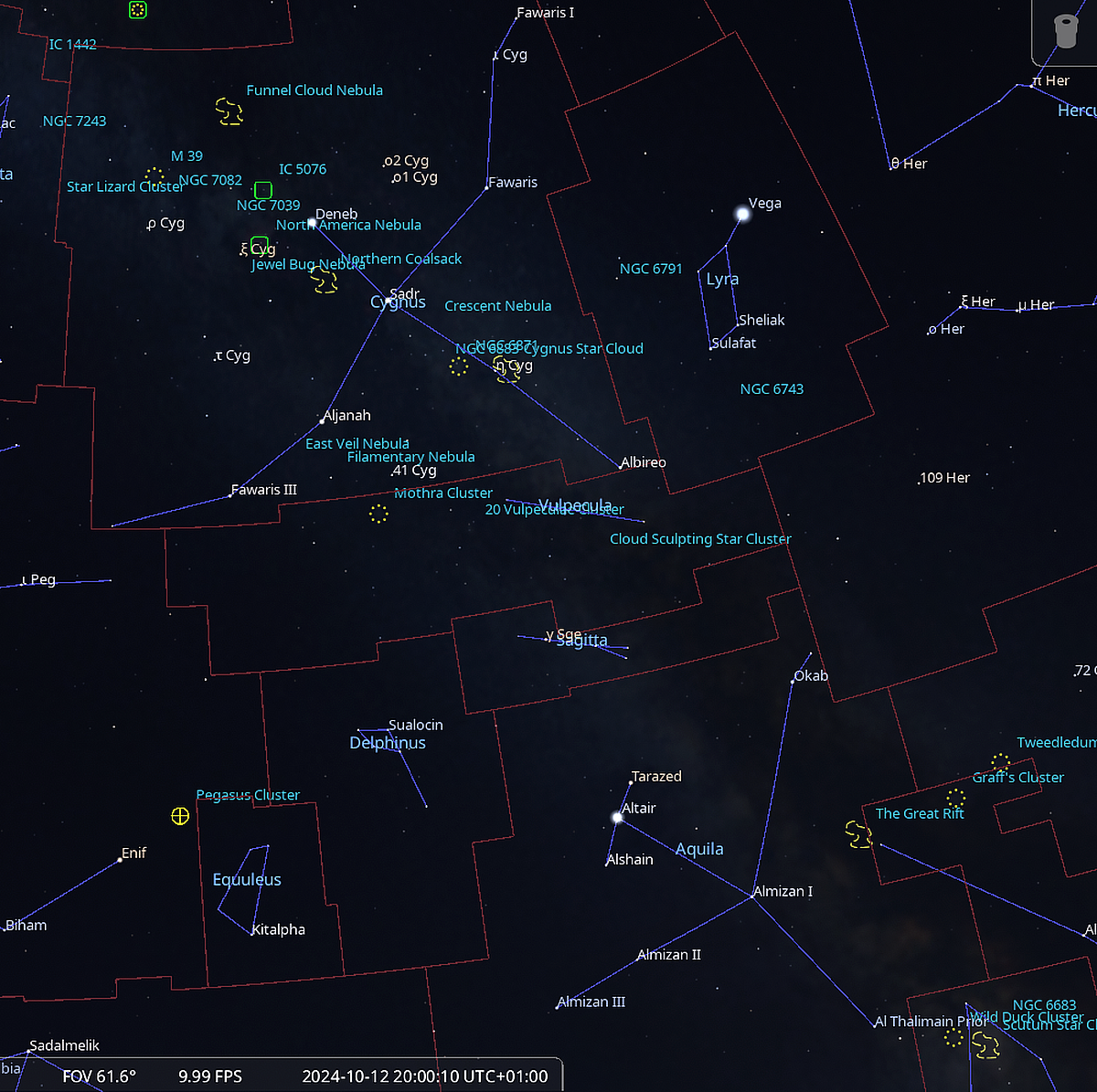
The October sky - central spine of sky to the south. (Click for full image)
Those unfamiliar with the night sky may assume that summer’s stars disappear once autumn arrives. However, as twilight deepens, many summer constellations remain well placed for observation.
The three bright stars of the Summer Triangle are especially prominent. Vega, with its striking steely-blue hue, stands out high in the north-west within the lozenge-shaped constellation Lyra.
Cygnus the Swan, also known as the Northern Cross, hangs like a cross from its brightest star, Deneb, high in the west. Lyra and most of Cygnus are circumpolar from our latitude and remain visible throughout the year because they lie far enough north of the celestial equator never to set. Of the Summer Triangle’s three stars, only Altair, the brightest star in Aquila the Eagle, migrates south for winter, setting in the west shortly after 22:30hrs by late October.
A short distance above Altair in Aquila lies the small, arrow-shaped constellation Sagitta, with the compact pattern of Delphinus to its left. With a little imagination, Delphinus resembles a dolphin leaping from the water; it is also sometimes called ‘Job’s Coffin’. Between Cygnus and Sagitta, a scattering of stars forms Vulpecula the Fox, home to the fine planetary nebula M27, the Dumbbell Nebula.
Straddling the southern horizon are the stars of Sagittarius the Archer, a constellation never fully visible from the UK. Under transparent skies early in the month look for the large ‘Teapot’ asterism, whose angular outline appears slightly tilted, as if pouring a cuppa. Sagittarius is rich in deep-sky objects and well worth exploring in particularly clear conditions. See the In Focus article, ‘The Archer—Part 2’.
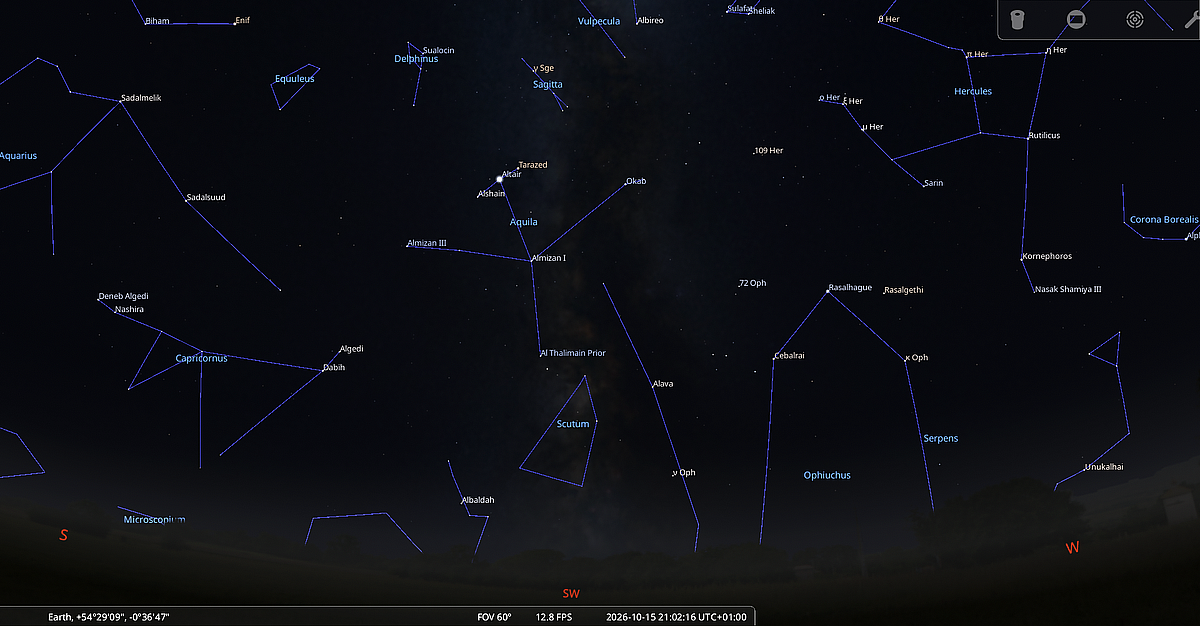
The October night sky Southwest aspect - 21:00hrs BST. (Click for full image)
Only a few constellations dominate the eastern sky, most notably Pegasus, the Winged Horse, which stands two to three hand-spans above the horizon. It is best recognised by autumn’s signature asterism, the Great Square: four stars enclosing an area with few stars visible to the naked eye. The square is a useful guide to the fainter constellations low in the east and south-east.
Moving clockwise around the square from its upper-left star, Alpheratz, we encounter Scheat, Markab and Algenib. Alpheratz, Alpha Andromedae, marks the starting point of Andromeda’s main star chain, which extends eastwards, and provides a useful route to the Andromeda Galaxy, our neighbouring large galaxy (see last month’s September Night Sky).
Below Andromeda lie two small constellations: Triangulum and, farther south, the crooked line of stars forming Aries the Ram. Triangulum contains M33, the third major spiral galaxy in the Local Group, alongside the Milky Way and Andromeda galaxies. Also known as the Triangulum Galaxy, M33 is about one-third their size, appears face-on from Earth and can be seen as a misty patch through binoculars or a rich-field telescope.

The Southeast aspect of the October night sky - 21:00hrs BST. (Click for full image)
Return to the Great Square and extend a diagonal line from Alpheratz through Markab, its lower-right star. This leads to the zigzag ‘Water Jar’ asterism in Aquarius the Water Bearer. One legend depicts it as Zeus pouring the waters of life from heaven. Several Aquarian star names begin with ‘Sad’, derived from the Arabic sa’d, meaning ‘luck’. Continue along the same line to reach Capricornus above the south-south-western horizon.
Towards the end of October, Fomalhaut—the most southerly first-magnitude star visible from the UK—begins its brief appearance. It marks the mouth of Piscis Austrinus, the Southern Fish, into which the waters of Aquarius pour. To find it, extend a line down through the Great Square’s two right-hand stars, Scheat and Markab, towards the southern horizon. Fomalhaut lies 25 light-years away and has a complex system of dusty debris belts possibly shaped by unseen planets in orbit around it.
If conditions permit, take the opportunity to explore the autumn night sky—a panorama spanning every season.
October Sky Charts.
 |
 |
|
Looking North
Oct 15th - 21:00hrs BST |
Looking East |
 |
 |
|
Looking South
Oct 15th - 21:00hrs BST |
Looking West
Oct 15th - 21:00hrs BST |
 |
 |
|
Northern Aspect
Oct 15th - 21:00hrs BST |
Southern Aspect
Oct 15th - 21:00hrs BST |
 |
 |
| Northern Aspect (dawn) Oct 15th - 06:00hrs BST |
Southern Aspect (dawn) Oct 15th - 06:00hrs BST |
Additional Image Credits:
- Planets and Comets where not otherwise mentioned: NASA
- Sky Charts: Stellarium Software and Starry Night Pro Plus 8
- Log in to post comments
